


Marine rubber fenders protect boats, docks, trucks, and equipment from collision damage. A poor cut creates gaps and uneven contact. It leads to premature wear. In high-impact marine settings, small fit issues turn into big maintenance problems.
This guide shares a practical workflow for on-site use. It focuses on clean, square cuts. It covers safe handling. It includes simple checks so the fender fits right before you fix it in place.
When Should You Cut a Rubber Fender?
Cut a rubber fender only if you can keep the profile intact. The structure must stay strong. Cutting helps for custom-length installs. It works for replacing damaged segments. It fits when standard lengths don’t match an existing layout.
People often cut to trim a long strip for a dock face. They split a fender into equal sections. They remove a damaged end to reuse the rest. On many sites, a clean on-site cut leads to a neat install faster.
Do not cut if it will damage internal reinforcement. This reduces structural strength. Some industrial profiles have embedded plates or internal structures for mounting strength. Cutting through them makes the fender lose load capacity. It can fail early.
If you are unsure about internal reinforcement, inspect first. Look for signs of embedded metal. Check for unusual stiffness in one zone. Read manufacturer markings for reinforced construction. When in doubt, stop and confirm before cutting.
A good cut has three traits. The cut face is straight and square. The edge is smooth enough to sit flush. The profile shape shows no crush, tear, or distortion.
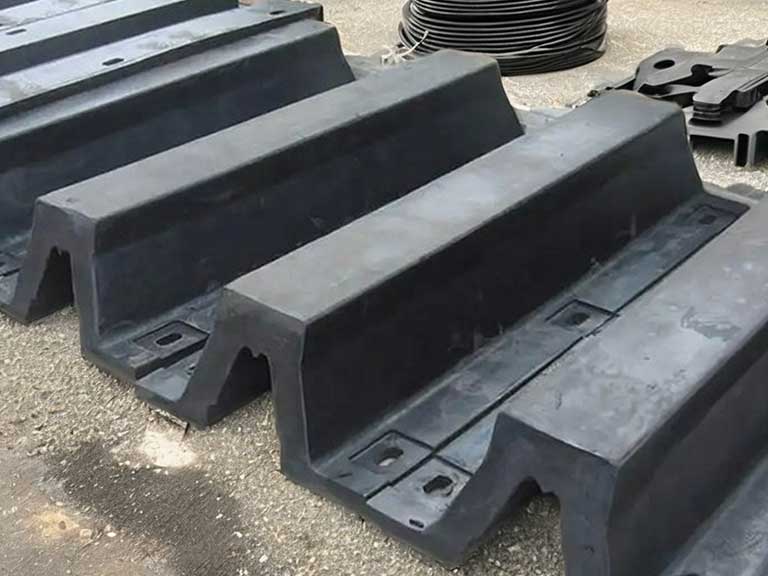
Tools, Safety Gear, and Workstation Setup
The fastest clean cut starts with a stable workstation. Match the tool to the rubber’s thickness. Many bad cuts happen when the fender shifts. The blade binds and tears the rubber.
You need a flat surface that won’t flex. A sturdy workbench works best. A thick plywood sheet on solid supports can do the job. Avoid cutting on uneven ground. The fender can roll and twist there.
Clamping is required. Use clamps that hold the fender firmly without crushing the profile. Place scrap wood pads between the clamp jaws and the rubber. This spreads pressure and prevents dents.
Safety gear matches the cutting method. For manual cutting, wear cut-resistant gloves and safety glasses. For power tools, add hearing protection. Use ventilation to control dust. Wear respiratory protection if dust forms.
Here is the minimum setup for most on-site jobs:
- Measuring tape and straight edge for alignment
- Chalk or marker for a visible cut line
- Clamps and a stable surface to prevent movement
- Sharp utility knife for thin rubber
- Fine-tooth saw for thicker rubber
- Gloves and eye protection for every method
If the site is cold, the rubber gets stiffer. The blade passes harder. Tearing risk rises. Plan for slower cutting. Use more controlled passes.
Choose the Right Cutting Method by Thickness and Fender Profile
Tool choice starts with thickness. Profile comes second. Thin, pliable rubber takes a sharp knife for a clean edge. Thick or solid rubber needs a saw for better control and a consistent cut face.
Thin or soft rubber fenders cut well with a heavy-duty utility knife. Do not use brute force. Make multiple shallow passes. Follow the line. Let the sharp edge work.
Thick or solid rubber fenders cut better with a fine-tooth saw. A hacksaw works for small jobs. A jigsaw with the right blade helps for wide or hard-to-handle fenders. For straight cuts on solid profiles, a miter saw works when you support the fender well.
Some crews try an angle grinder on rubber. It can work in rare cases. But it raises risk. Grinders create heat. They can grab the material. They make dust. If you cannot stabilize the fender fully and control the path, pick a saw instead.
Watch for warning signs of the wrong method:
- Rubber tears instead of slices.
- The blade is dull, or the methodis too aggressive.
- The cut line wanders.
- The fender moves, or you lack a guide.
- Rubber bounces under a power tool. Support is not enough.

Cutting Method Quick Guide
| Fender thickness / feel | Best primary tool | Why it works | Key control tip |
|---|---|---|---|
| Thin / soft / flexible | Utility knife | Clean slicing when rubber yields | Multiple shallow passes |
| Medium / firm | Fine-tooth hand saw or jigsaw | Better control, less tearing | Slow, steady feed |
| Thick / solid | Fine-tooth saw or miter saw | Straighter cut face, repeatability | Stabilize both sides of cut |
| Unstable setup or unknown internal structure | Stop and reassess | Avoid damage or unsafe cutting | Inspect and confirm first |
This table focuses on tool behavior and rubber behavior. It does not push brands. If the tool fights the material, change your approach. Do it before you waste time.
Step-by-Step: How We Cut Rubber Fenders for a Clean, Square Edge
A clean cut follows a repeatable workflow. Mark precisely and clamp firmly. Prep the cut. Then cut with the right rhythm. Follow these steps in order. You reduce frayed edges and misalignment.
First, decide if you need an allowance. For a perfect fit against a corner or end point, leave a small extra length. This allows micro-trimming. It prevents an irreversible over-cut.
Measure and Mark with Straight-Line Control
Measure the needed length. Mark it clearly. Use a straight edge to connect marks across the fender face. This helps for wide profiles. A single dot gets missed easily once cutting starts.
Make the cut line visible from your cutting angle. If the fender is dark and the site lighting is poor, use chalk or a paint marker. It makes the line easy to track.
For multiple identical pieces, create a simple template. It reduces measurement error. You repeat the same cut length without re-measuring each time.
Secure the Fender So It Cannot Roll or Twist
Clamp the fender to a stable surface. Place clamps on both sides of the cut line. Not directly on the line. The goal keeps the profile stable. It prevents rotation.
Support the free end. It must not sag during the cut. Sag pinches the blade. It causes tearing or a crooked cut face.
If the fender has a curved profile, use scrap wood blocks. They prevent rocking. Stability drives quality most.

Pre-Cut Prep: Reduce Friction and Control Stiffness
For knife cuts on firm rubber, use a mild lubricant. A small amount of soapy water helps the blade move smoothly. It reduces binding. Do not flood the area. Slipping is a safety risk.
If the rubber is very stiff from cold, warm it gently. Warm only to make it more pliable. Not to distort it. If the profile deforms, stop and let it cool.
The goal is simple. You want a controlled cut. Not a fight against resistance.
Make the Cut with the Correct Rhythm
For knife cuts, avoid one deep pass. Score the line lightly first. Deepen it with several shallow passes. Keep the blade aligned to the straight edge when possible.
Replace dull blades early. A dull blade forces a harder push. It raises injury risk. It creates ragged edges. Sharp blades cost less than wasted fender.
For saw cuts, move slowly and steadily. Let the teeth work. Keep feed rate consistent. If the saw bounces, stop. Improve support and clamping first.
For powered saws, keep your hands clear. Keep your stance stable. Avoid twisting the tool mid-cut. Twisting widens the cut face. It makes an uneven edge.
Dry-Fit Check and Micro-Trim Before Final Fixing
After cutting, place the fender in position. Check contact. A dry-fit shows small issues before fixing. If the piece is slightly long, micro-trim it. Do not force it.
Check the cut face against the mounting plane. If not square, the fender may leave a gap. A small fix now saves time later.
For multiple segments, dry-fit the first one. Use it as a reference for the next cuts. This keeps consistency.
Finish, Inspect, and Fix Common Issues (So the Fender Sits Flush)
Finishing and inspection turn a cut piece into an install-ready piece. A clean edge improves fit. It reduces snag points. It helps the fender sit flush against the surface.
Start with edge cleanup. Remove small jags with a knife. Use controlled trimming strokes. Then sand or file the cut face and edge transitions. You do not need polish. You need even contact.
Inspect three things before you call the cut complete. Check if the cut face is square. Check if the profile is crushed. And check if the fender sits flush along the contact area.
For a quick acceptance check, use this list:
- The cut face looks straight from multiple angles
- The edge feels smooth enough to avoid snag or peel
- The fender sits flush during dry-fit, without forced bending

Troubleshooting: Ragged Edges or Tearing
Ragged edges come from a dull blade. Or too much force. Or too deep a pass. Switch to a fresh blade. Return to shallow passes. Improve support so the rubber does not flex away from the blade.
If tearing continues, the rubber may be too thick for a knife. A fine-tooth saw often gives a cleaner cut on dense profiles.
Troubleshooting: The Cut Line Wanders
A wandering cut line is almost always a setup issue. Improve marking. Use a straight edge as a guide. Increase clamp stability. If the fender moves, it will wander.
If you must freehand, slow down. Use short controlled strokes. But guide the tool whenever possible. Do not rely on sight alone.
Troubleshooting: Power-Tool Bounce or Heat Issues
Bounce happens when the fender lacks support on both sides. Add supports under the free end. Increase clamping. Reduce feed rate. Keep the tool aligned.
Heat issues show as smeared edges or deformation. Cut slower. Control better. Avoid aggressive contact. If heat is hard to manage, switch tools.
When to Stop and Outsource the Cut
Stop if you suspect internal reinforcement. Stop if a safe, stable setup is impossible. Stop if the cut needs complex geometry, as you cannot guide accurately on-site. In those cases, professional cutting often costs less than wasting lengths.
Conclusion
A rubber fender cut does not need to be complex. It must be controlled. Choose the tool by thickness and profile. Build a stable setup. Use clear marking and firm clamping. Cut with the right rhythm. Use shallow passes for knives. Use a slow, steady feed for saws.
Dry-fit before permanent fixing. Those steps prevent gaps. They reduce rework. They help the fender sit flush as intended. Follow this workflow. You get clean, install-ready results on-site. You protect material value and safety.

FAQ
What’s the best tool for cutting a rubber/D fender by thickness?
Is it safe to use power saws on rubber fenders?
Can all rubber fenders be cut, and how do I check first?
How do I smooth the edge so it sits flush?
Talk to our team.
Share a few details about your project — vessel, port, or operation. We'll reply within 24 hours.