

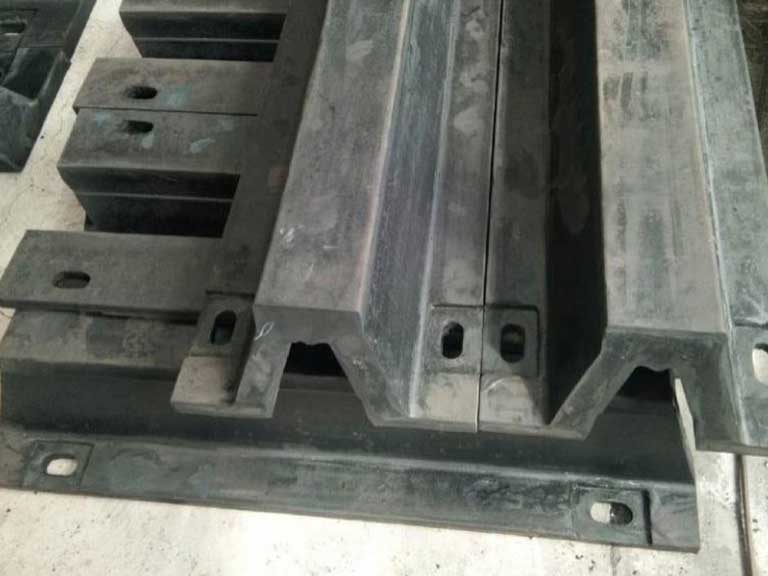
To keep rubber fenders from getting damaged, keep them out of the sun, chemicals (oils, solvents, acids), and extreme temperatures. Make sure that docking is smooth and controlled with the right pressure and load distribution. Clean them regularly with mild soap and soft brushes, and check and maintain the hardware and air pressure, using UV protectants to make them last longer.
What Rubber Fenders Do and Why They Still Fail
Rubber fenders absorb collision energy between a vessel and a quay, or between two vessels. They convert kinetic energy into controlled compression so steel structures don’t take the hit.
They still fail because energy, friction, or installation loads exceed what the fender system can tolerate. In practice, damage is usually triggered by sliding contact, peak berthing energy, or weakened anchoring hardware.
Learn More: What Is The Purpose Of The Rubber Fender?
Primary Types of Rubber Fenders and Potential Causes of Damage
Different types of rubber fenders face different damage modes. Knowing the type helps you prevent the most common failure pattern instead of “maintaining blindly.”
| Type | Typical Use | Most Common Damage Mode | Best Prevention Focus |
|---|---|---|---|
| Chain-net pneumatic | High-energy berths, large ships | Rope abrasion / pressure issues | Correct pressure + protect contact points |
| Sling pneumatic | Mixed berths, frequent handling | Handling abrasion / sharp contact | Lift correctly + avoid dragging |
| Molded (D/V/arch) | Fixed quay protection | Shear abrasion / cracking | Approach control + strong anchoring |
| Extruded | General protection | Long-term rubbing / local deformation | Reduce sliding + flat, secure supports |
Chain-net Pneumatic Rubber Fender
A chain-net pneumatic rubber fender is an air-filled fender protected by a chain-and-net system. It fits exposed berths and large vessels where energy levels are high.
It is less tolerant of sharp edges, poor rope routing, and low/incorrect internal pressure. Most avoidable damage comes from improper pressure management and abrasion at rope contact points.

Sling Pneumatic Rubber Fender
A sling pneumatic rubber fender is an air-filled fender carried by slings for easier handling. It suits ports and terminals that need fast deployment and repositioning.
It can be damaged by improper lifting/dragging, sharp contact points, or uncontrolled sliding against the hull. Keep the sling layout correct and avoid abrasive handling surfaces.
Molded Rubber Fenders
Molded rubber fenders include common fixed shapes used on quay walls. Many facilities use D-type fenders and V-type super arch rubber fenders in daily service.
They often suffer from friction shear and structural cracking when the approach angle/speed is poor or when the vessel “walks” along the berth. Stable anchoring and anti-friction face protection matter most.
Extruded Rubber Fenders
Extruded rubber fenders are profile fenders made by extrusion and used on a wide range of berths and vessels. They are a practical option where loads are moderate and installation is straightforward.
They are more sensitive to continuous rubbing, misalignment, and local stress from uneven supports. Control tangential movement and keep the mounting surfaces flat and secure.
Main Causes of Rubber Fender Damage
Most damage falls into four buckets. If you identify the bucket early, the fix is usually simple and low-cost.
Friction & Abrasion
Friction damage happens when the vessel approaches with high tangential speed and the hull “slides” along the fender. The fender surface can show corner dropping, cracking, and abrasion.
This is common in fixed D-type and V-type rubber fenders. Repeated small sliding events can be worse than one clean, controlled compression.
Overloading
Overloading occurs when berthing energy exceeds the fender’s design capacity. Cracks often appear along the length direction, especially at structural weak points in D-type and V-type super arch rubber fenders.
Overloading is not only “too heavy.” High speed, poor approach angle, or bow-first contact can create peak loads that exceed the fender’s safe compression.

Poor Connections & Installation
Poor anchoring is a system failure, not just a “bolt problem.” Corroded chains, anchor bolts, and mounting parts loosen over time in a marine environment and reduce load transfer capacity.
Once hardware loosens, impact loads concentrate locally, and damage accelerates. A small amount of play in fittings can turn normal berthing into tearing and cracking.
Environmental Degradation
UV exposure, temperature extremes, oils/solvents, acids/alkalis, and marine growth can degrade rubber compounds. The result is hardening, loss of elasticity, and reduced resilience under repeated compression.
Environmental stress usually works slowly. It becomes dangerous when combined with friction or poor hardware, because the rubber can no longer “recover” normally.
Cause → symptom → action (field reference):
| Cause | Typical Symptoms | First Action |
|---|---|---|
| Friction/abrasion | Surface wear, corner dropping, shear cracks | Reduce sliding, improve berthing practice, add facing protection |
| Overloading | Long cracks, permanent deformation | Control speed/angle, verify capacity match, ensure proper contact |
| Poor connections | Loose nuts, shifted panels, corrosion | Tighten/repair, replace corroded parts, check alignment |
| Environment | Hardening, discoloration, surface checking | Shield from exposure, clean deposits, avoid chemicals |
How to Identify Damage Early
You identify fender damage early by systematic visual checks plus hardware checks on a fixed schedule. Small defects become failures when you keep berthing without correcting the trigger.
Quick Visual Check
Inspect the full contact zone and edges. Look for surface abrasion, deep cuts, cracks, bulges, and permanent deformation.
For pneumatic rubber fenders, also look for abnormal shape, scuffing around rope contact, and valve area damage. If a defect is growing between inspections, treat it as “active damage,” not cosmetic wear.

Hardware & Structure Check
Check whether the foot bolts for installing the fender body and the bolts fixing the anti-impact/anti-collision plate are loose. If loose, tighten to spec and secure where required by your site practice.
Inspect the anti-collision plate for dents, cracks, forward tilting, and corrosion. Also, check the concrete/backing for cracks that can reduce anchoring integrity.
Pneumatic Fender Check
Check whether the fender is damaged and whether the air pressure is normal. Confirm valves and caps are intact and that ropes do not run over sharp edges.
Incorrect pressure makes every berthing event harsher. Treat pressure verification as part of normal operation, not “maintenance only.”
When to Repair, Re-position, or Replace
Use a simple decision rule:
- Repair if damage is shallow/local and the root cause is corrected.
- Re-position if contact alignment is wrong or fittings allow the fender to shift.
- Replace if cracks are deep, deformation is permanent, layers separate, or fittings can’t be restored safely.
Learn More: How To Replace And Install Rubber Fenders?
Best Practices to Prevent Damage During Use
The most effective prevention is controlling approach behavior and eliminating sliding contact while keeping the fender system tight and clean.
Berthing & Mooring Practices
Train operators to manage approach speed, angle, and first contact point. Aim for controlled compression, not rubbing or bow-first shock loading.
Avoid repeated forward/back movement along the berth that creates shear abrasion. If repositioning is required, do it with controlled assistance rather than scraping the fender.
Load Control
Do not overload the vessel for the berth design and fender capacity. Also, reduce peak energy by controlling approach speed, especially in wind/current conditions.
If your operation changes, such as larger vessels, different approach geometry. Please recheck whether the installed fender capacity still matches the job.

Cleaning & Routine Maintenance
Clean salt deposits and marine growth to reduce chemical and biological degradation. Keep the fender surface free of debris that can cut or grind the rubber under load.
Tighten fasteners on schedule and replace corroded metal parts early. Hardware condition often decides fender life more than the rubber “brand” does.
Protective Measures
Use corrosion-resistant materials or protective coatings for bolts, chains, and steel fixtures. Consider protective treatments suited for marine rubber to reduce UV and contamination damage.
Do annual anti-corrosion treatment where applicable, especially on plates and exposed steel hardware. Replace damaged panels promptly to prevent underlying rubber damage.
Storage and Handling Requirements
Proper storage prevents “damage while idle.” Most storage damage is caused by sunlight, heat, chemicals, or deformation from poor stacking.
- Storage Environment: Store rubber fenders in a covered, well-ventilated area. Keep them away from rain, snow, and standing water. Plan enough floor space to avoid crushing and forced bending. Keep storage organized so fenders are not dragged across abrasive surfaces.
- Temperature & Distance to Heat Sources: Keep storage temperature at -15°C to 40°C and maintain at least 1 meter from heat sources. Avoid high-temperature areas that soften rubber and accelerate aging.
- Chemical Isolation: Prevent contact with acids, alkalis, oils, and organic solvents. Keep the storage area clean and free of chemical containers that can leak or splash.
- Handling: Use proper lifting equipment and correct hoisting methods. Do not drag fenders on the ground or across sharp edges.
For rubber fenders, maintain correct air pressure during storage and handling where required by the product specification. Incorrect handling creates abrasion and cuts that later become “mysterious” failures in service.

Conclusion
Rubber fenders protect vessels and infrastructure by absorbing berthing energy. You extend their life by preventing sliding abrasion, avoiding overload peaks, keeping connections tight, and controlling storage conditions.
At Zhonghaihang Shipping Supply, we see the same pattern worldwide: most fender “failures” begin as small, visible issues that were easy to fix early. Use the checks and practices above to keep your marine fenders reliable and your operations safe.
FAQ
What are the most common causes of rubber fender damage?
How often should rubber fenders be inspected?
How can I reduce abrasion on D-type and V-type fenders?
When should a rubber fender be repaired versus replaced?
Talk to our team.
Share a few details about your project — vessel, port, or operation. We'll reply within 24 hours.