

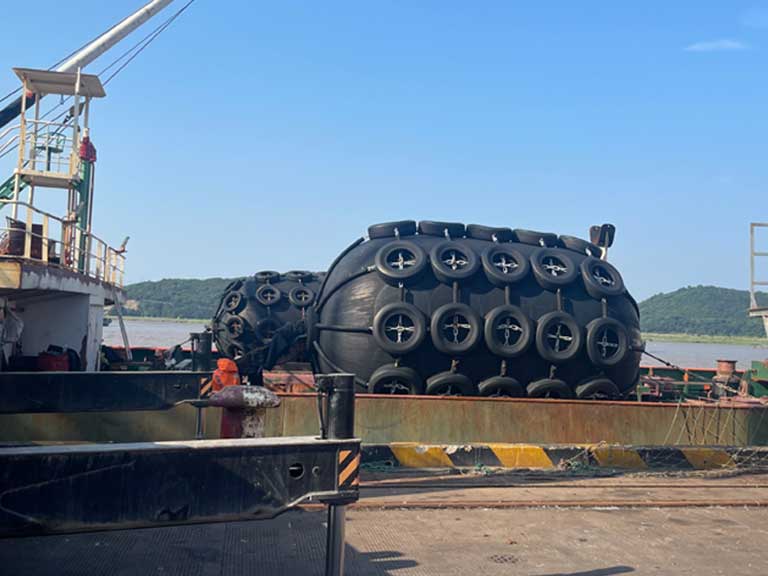
For maritime personnel, the use of high-quality rubber fenders is of utmost importance. Rubber fenders, also known as dock buffers, are designed to withstand the pressure generated when a vessel collides with a dock or another vessel. This helps prevent damage to both the vessel and the dock. There are various types of rubber fenders available, each suited for different applications.
Zhonghaihang Shipping Supply designs and manufactures various types of marine equipment. These include foam fenders, pneumatic fenders, and rubber fenders for boats. These important components ensure the safety of ships and docks during mooring and berthing operations.
When choosing the right rubber dock fender, several service elements must be considered. These include the type of dock structure, type and size of the vessel, berthing speed, berthing method, currents, and wave action. Below are the top 10 commonly used rubber dock fenders.
What Are Rubber Fenders?
Rubber fenders are a type of collision prevention device. During berthing activities, rubber fenders are used to shield vessels and dock equipment from harm. Their function is to absorb the energy of ship collisions. This helps reduce the risk of damage to ships and docks.
Some important things about good rubber fenders make them good at what they’re supposed to do. Some of these are longevity, ability to absorb energy, cost-effectiveness, and adaptability.
| Property | Description | Benefit |
| Durability | Long-lasting and resistant to wear | Reliable choice for busy ports and docks |
| Energy Absorption | Absorbs energy during vessel impact | Reduces damage to vessels and docks |
| Cost-Effectiveness | Prevents frequent repairs | Saves money in the long run |
| Versatility | Effective across various maritime environments | Suitable for ports, offshore platforms, and smaller boat docking |
Zhonghaihang Shipping Supply makes sure that our rubber fenders are of the best quality. They have high energy absorption, resistance to tension set, resistance to tear, and resistance to abrasion. We rigorously test our materials and strictly adhere to international manufacturing standards. This ensures that they always perform well.
Types Of Rubber Fenders for Various Applications
Super Cone Rubber Fender
Super cone rubber fender represents the third generation of drum rubber fenders. It utilizes a revolutionary tapered rubber body and front steel frame structural design. It increases the design shrinkage deflection of the fender from 52.5% to 70% without increasing the reaction force.
As a result, it has become one of the finest rubber dock fenders available today. Its presence eases the structural design of docks and reduces the cost of dock construction. It is an excellent alternative to super drum rubber fenders.
Tapered rubber fenders are 10 years old. Its shape has become the new trend in rubber dock fender design.
Features:
- Approximately double the energy absorption compared to the corresponding size of rubber dock fenders.
- The small-size TD-AA Tapered Rubber Fender can replace the large-size TD-A Super Drum Rubber Fender under the same conditions of product reaction force and energy absorption. And TD-AA800H tapered fender can replace the TD-A1000H fender. Therefore, it can significantly reduce the cost of the terminal project.
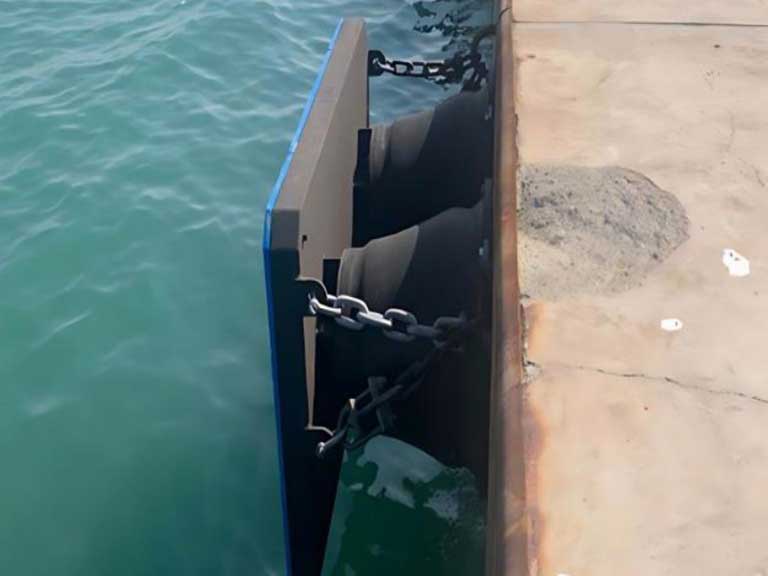
Super Cell Rubber Fender
Super cell rubber fender has a long history and its current structure is a product of continuous development. Its front panel can greatly reduce the hull pressure. As a result, this rubber dock fender is ideal for berthing large vessels.
Features:
- Super cellular rubber fenders have an E/RH value that is approximately 15% higher than traditional rubber fenders. The side E/RH value is typically 0.43-0.44. Hence, it has higher energy absorption and lower reaction forces.
- SC rubber fenders are more structurally sound than standard rubber fenders. A rounded over head is used between the fender body and the flange. This increases the stress concentration phenomenon when the fender root is subjected to extrusion and deformation. As a result, the fender is more rationally stressed, and the shrinkage rate is increased from 47.5% to 52.5% for the standard type.
- SC rubber fenders are fitted with bolt hole spacing and bolt holes reversed from standard rubber fenders.
- Super Cellular Rubber Fenders have little effect on tilting berths.

D Type Rubber Fender
Type D rubber fender is gaining popularity for its adaptability and superior protection. It consists of marine-grade flexible polyvinyl chloride (PVC), which offers the highest durability and lowest cost. For this reason, it is also one of the most common rubber dock fenders.
Features:
- This rubber fender has the right reaction force and energy absorption.
- It has a reasonable bottom width for better compatibility with framed docks.
- Type D rubber dock fender is lightweight and easy to maintain.
- It is ideal for small docks, fishing boats, tugboats, barges, and pontoons.

DO Type Rubber Fender
DO type rubber fender is also known as wing fender. It is a new type of rubber dock fender derived from a Type D rubber fender. It has greater reaction force and energy absorption capacity than D type fender. Therefore, it is often used to protect ship barriers, docks, and harbors.
Features:
- High energy absorption and strong reaction force.
- The small bottom width makes it ideal for framed piers.
- DO type rubber fenders are strong and durable.
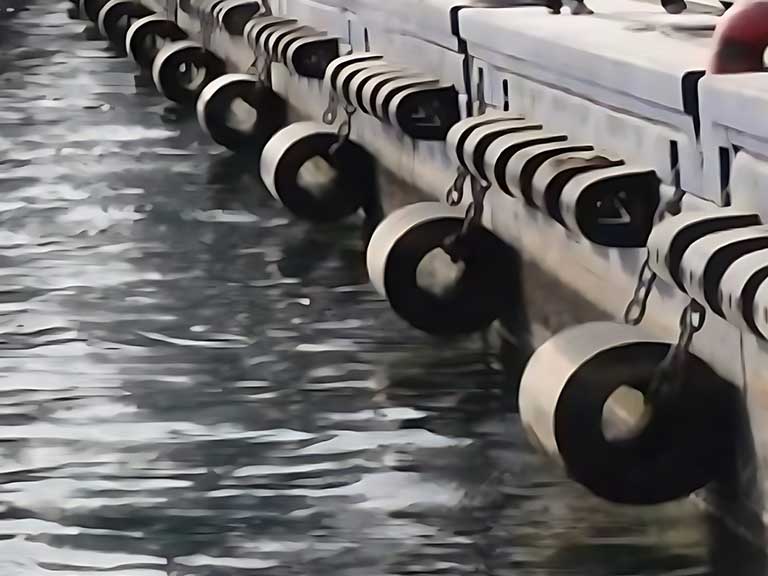
Cylindrical Rubber Fender
The cylindrical rubber fender is a simple but adaptable marine fender design. It has a long history of use and is simple and adaptable. They are usually suspended from the hull and are suitable for any size vessel.
Features:
- Cylindrical rubber fenders offer low reaction forces, low surface pressure, and proper energy absorption.
- Highly adaptable to roll and pitch when the vessel is moored.
- Widely used, it can also be used as a ship collision avoidance device.
- The cylindrical rubber fender is easy to maintain.
V Type Rubber Fender
Type V rubber fenders are often called arch fenders. This arch rubber fender is one of the most widely used rubber dock fender systems in the world. Its simple design makes it easy to install and requires low maintenance. It is suitable for applications where space or height is limited.
Features:
- The V-Rubber Fender has moderate reaction forces and high energy absorption.
- The unit is durable and simple to assemble.
- It is ideal for medium-sized docks.
W Type Rubber Fender
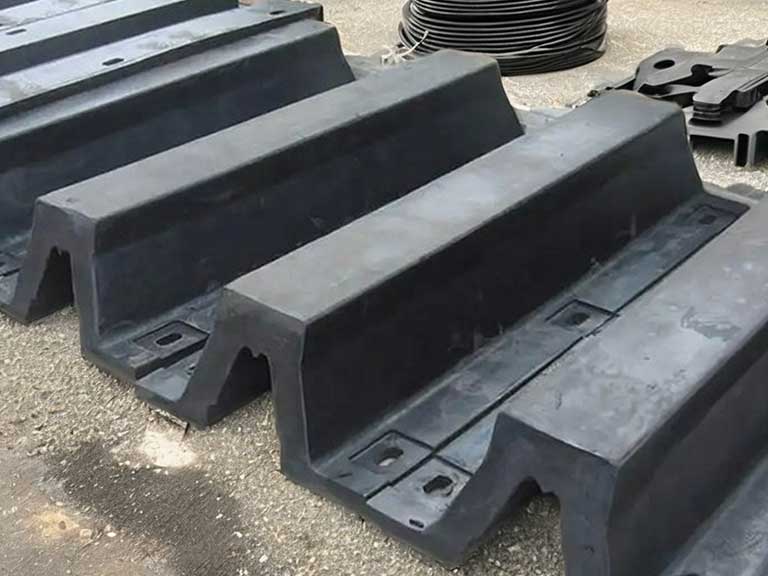
The Type W Rubber Fender has mounting holes on both sides and is flexible enough. As a result, it can effectively cushion the collision force between the wharf and the vessel during mooring and berthing operations. It has a unique double “leg” structure with a center control section. Therefore, it is suitable for protecting the mooring portion of pontoons or bridge piles.
Features:
- Type W rubber fenders have a wide top area and low pressure on the contact surface.
- Marinas weighing more than 10,000 tons benefit from high energy absorption and low reaction forces.
- The distance between the two support arms is adjustable and compression deformation of up to 52.5% is possible.
- The surface layer of the anti-vibration plate is made of UHMW polyethylene or nylon with a low coefficient of friction.
- They can be installed vertically or horizontally without the need to support anchor chains.

Roller Rubber Fender
Roller rubber fender absorbs the collision energy of the ship through the rotation and compression of the roller. When the ship is berthing or moving, the roller fender can rotate with the movement of the ship. This ensures the safety of the dock and the ship. Roller rubber fenders can be used in shipyards, marinas, ro-ro docks, dock corners, and other places where the direction of ship movement and berthing speed must be limited.
Features:
- The Roller Rubber Fender rotates around three axes, which limits the speed of the ship and ensures safe berthing.
- Its compression set can approach 40%, which is more than twice the energy absorption of traditional rotating fenders.
- Roller fenders rotate with the movement of the ship’s hull. Therefore, there is no sliding friction between the hull and the fender, making it difficult to damage the hull paint.

Pneumatic Rubber Fender
Often referred to as Yokohama fenders, pneumatic fenders are a popular type of floating fender. It is made of rubber sheets reinforced with synthetic fiber rope and filled with compressed air at an initial pressure of 50kpa or 80kpa.
As a result, it floats on the water surface and acts as a shock absorber between two ships. On the other hand, it is widely used in harbors and marinas to protect vessels during mooring activities.
Features:
- Wide range of sizes and high adaptability.
- High energy absorption, ideal for large and medium-sized harbors and ships.
- No fear of collision and low coefficient of friction.
- Simple installation and maintenance.

Corner Rubber Fender
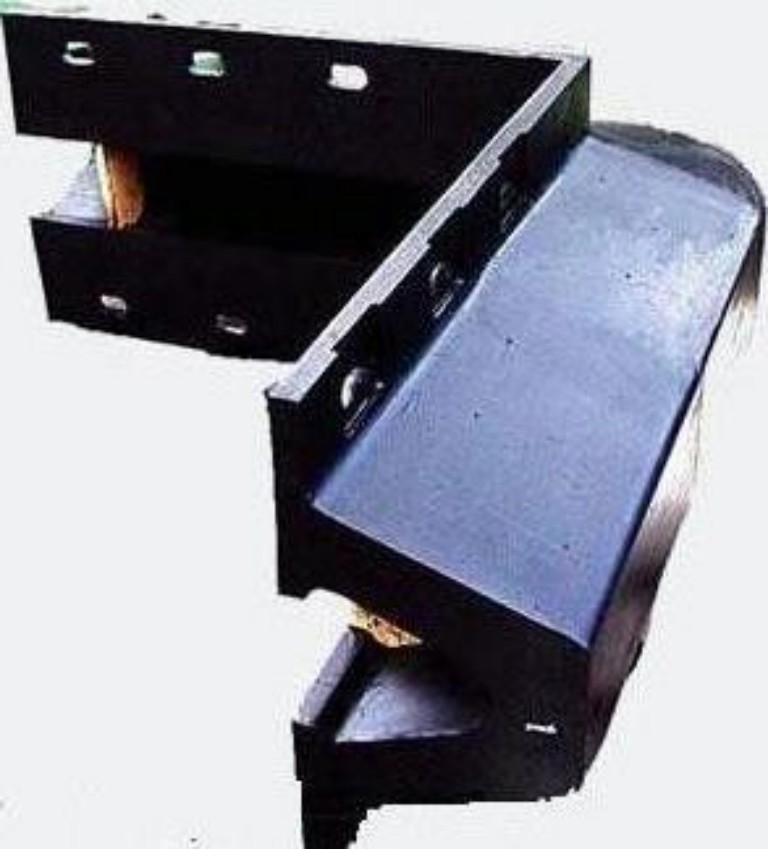
A Corner Rubber Fender, also known as a tugboat fender, is a kind of cylindrical fender. These rubber fenders are commonly used for pushing, setting up, extending, and tilting operations of various tugboats. Due to their unique design, these tugboat fenders are ideal for protecting rounded contours.
As such, they are typically installed on the bow and stern of tugboats for harbor operations. In addition, they can also be installed on both sides of the tugboat.
Features:
- Corner rubber fenders have high resilience properties.
- Easy to install and simple to maintain.
- Excellent resistance to ozone aging and UV radiation.
Specialized Rubber Fender Solutions
Advanced fender systems are essential for modern ports. They ensure the safety of ships and infrastructure during berthing. Zhonghaihang Shipping Supply offers a range of professional rubber fender solutions. This allows us to meet the unique needs of various port operations.
Foam-Filled Fenders: Foam-filled fenders offer a reliable and durable solution for port applications. These fenders are designed to absorb berthing energy while minimizing the risk of damage to vessels and structures. With a long design life of 5-15 years for general cargo berths, they provide a cost-effective solution.
Tugboat Fenders: Tugboat fenders are designed for use in tight spaces and for vessels that require additional protection during berthing. These fenders are carefully designed to withstand frequent berthing and unberthing operations. Therefore, they are ideal for high-traffic ports.
Custom Fender Systems: We develop custom fender systems through a comprehensive analysis of berthing energy requirements, structural limitations, and operational parameters. Our customized systems typically integrate multiple types of fenders and specialized components. They provide comprehensive protection solutions for complex mooring scenarios.
Zhonghaihang Shipping Supply comprehensively considers factors such as material selection, long-term costs, and clear division of responsibilities between port owners and ship operators. This helps ensure that the fender system meets the specific needs of each port. Our solutions are designed to offer a range of advantages. These include reduced maintenance costs and extended service life.

Summary
In conclusion, rubber dock fenders play a vital role in protecting boats and docks from damage. The right type of rubber dock fender needs to be selected based on factors such as size, shape, and environmental conditions. This provides a safe and smooth docking experience for marina owners and marine professionals.
Understanding the different types of rubber dock fenders and their applications will ultimately help you make an informed decision. This can extend the life of your docks and boats, ensuring their functionality and appearance. If you still have questions, you can contact us.
Zhonghaihang Shipping Supply has extensive expertise in designing and manufacturing high-performance marine fender systems. We offer a wide range of rubber dock fender products for multiple purposes to choose from. They can be used to protect docks, pier berms, and other marine environments.
In addition, Zhonghaihang Shipping Supply can provide you with different types of pneumatic fenders. They are suitable for protecting most vessels. Please contact us so that we can provide you with a customized fender solution that meets your specific criteria.
FAQ
How do different types of rubber fenders absorb energy during berthing operations?
What is the significance of reaction force in fender system design?
How to determine the appropriate size and type of fender for a specific vessel or port?
What are the benefits of using custom fender systems?
How do rubber fenders contribute to safe and efficient maritime operations?
Talk to our team.
Share a few details about your project — vessel, port, or operation. We'll reply within 24 hours.