

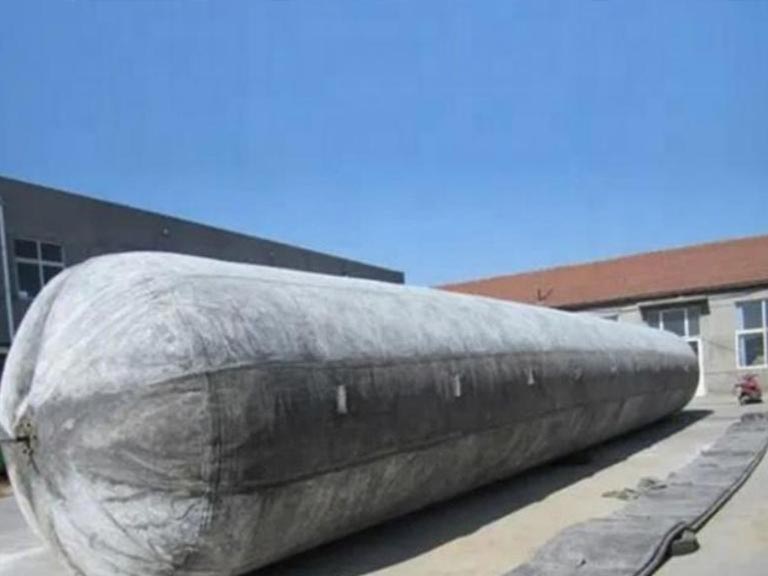
Marine salvage airbag is a buoyancy device used in marine salvage. Marine salvage is the process of returning a vessel and its cargo to its original location after an accident at sea. Salvage work may include towing, refloating a vessel, or repairing a vessel. Nowadays, it is important to ensure that coastal areas are protected from oil and other harmful substances. Most salvage work is now carried out by specialist salvage companies with their own specialized personnel and equipment.
Understanding Marine Salvage Airbags
Marine salvage airbags are specialized equipment used in various maritime operations. These include salvage, recovery, and refloating of vessels. These airbags are made of robust rubber construction with multiple synthetic-tire-cord layers, providing superior strength and durability in challenging underwater environments.
Our marine salvage airbags utilize a unique design that allows for significantly higher buoyancy capacity compared to conventional lift bags. They can generate 1-200 tons of lifting force while maintaining safer operating pressures. The enclosed design provides more controlled buoyancy, allowing for precise positioning and gradual lifting.
Key Differences from Other Lifting Solutions
Unlike standard PVC underwater airbags. Zhonghaihang Shipping Supply’s marine salvage airbags are made of rubber and multi-layer synthetic tire cord, making them more durable and robust. Although they may be slightly heavier than PVC alternatives. However, their superior durability and puncture resistance make them the preferred choice for professional salvage operations.
Some key benefits of our marine salvage airbags include:
- Robust rubber construction with multiple synthetic-tire-cord layers for superior strength and durability.
- Significantly higher buoyancy capacity compared to conventional lift bags.
- Controlled buoyancy for precise positioning and gradual lifting.
- Superior wear resistance and puncture protection.
- Flexibility to provide exactly the required amount of lift during complex salvage operations.
Types of Marine Salvage Airbags
Understanding the diverse types of marine salvage airbags is essential for selecting the right equipment for complex marine salvage missions. We offer a range of airbags designed to meet the unique demands of various underwater operations.
Totally Enclosed Marine Salvage Airbags
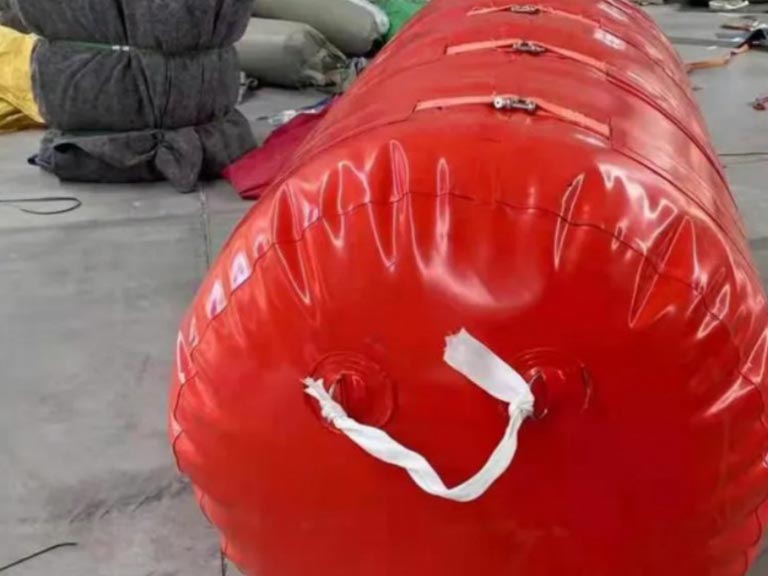
These marine airbags have a completely sealed cylindrical design. These marine salvage airbags are also known as salvage pontoons, enclosed airbags, or inflatable buoyancy devices. Enclosed lifting bags are designed to lift objects to or near the surface. They are therefore not “underwater air lift bags”.
These airbags are used on both sides of the submerged vessel and connected by underwater slings. When the compressor is filled with air, the buoyancy of the airbag can float the submerged vessel to the surface.
Relative Merits Of Enclosed Marine Salvage Airbags
Normally, the companies that manufacture airbags use PVC-coated fabric to make fully enclosed airbags. These marine salvage airbags are very compact and lightweight when not inflated, making them easy to move and use. When the boat is near the surface, the sailors can place the airbags under the boat. Then, one end of the airbag is located on each side of the boat, which can raise the boat to a sufficient height.
When the water is shallow, people can tie the two airbags together. Then, like floats, they can be placed on each side of the boat. The closed salvage airbag is equipped with an automatic valve that can automatically release air pressure. The valve opens when the internal pressure reaches a set value. In addition, it has the following advantages:
- Lightweight and easy to use
- Saves storage and transport costs
- Can be reinforced for heavy-duty use
- Easy to install
- Pipe buoyancy support
- More buoyant than rubber airbags
One of the biggest disadvantages compared to marine rubber airbags and steel buoys is that they are easily damaged. This is because the material used to make them is really thin. That is why manufacturers sometimes add extra coverings or spray polyurethane skins to make them stronger.
Application Of Enclosed Marine Salvage Airbags
Totally enclosed lifting bags are used by salvage crews for salvage and floating operations at sea. They are also used to make pontoons to support the weight of bridges, floating platforms, dock gates, underwater objects, or military equipment.
On the other hand, fully enclosed airbags are an effective floating method. They can reduce the draft of a ship and allow it to move better. In addition, these marine airbags can also be used to hold cables or pipes.
Marine Salvage Rubber Airbags
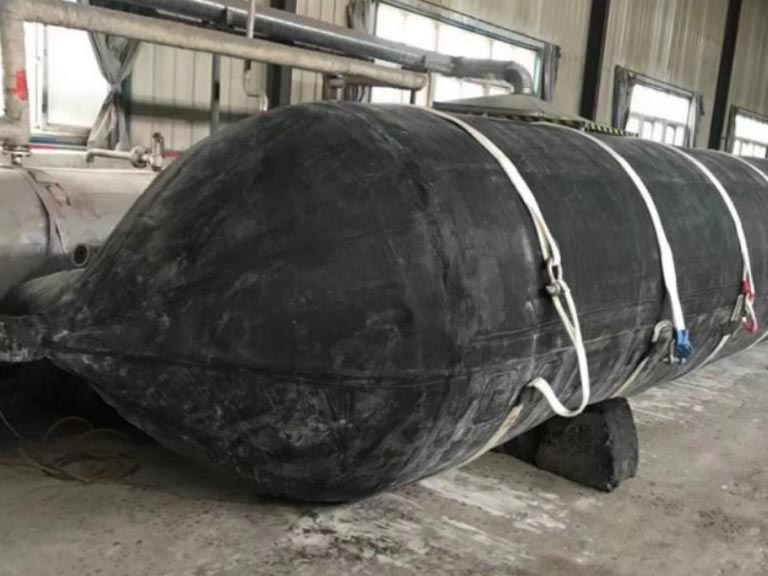
The rubber airbags used for launching ships have evolved into marine salvage rubber airbags. All manufacturers of marine salvage rubber airbags use heavy-duty synthetic tire cord plies with an inner and outer rubber layer in the shape of a cylindrical balloon. Initially, these airbags were used to lift heavy loads or launch ships. Later, the rubber airbags were added to lifting belts and used as marine salvage airbags.
A rubber marine salvage airbag has two conical heads on a cylindrical body. There is a swivel joint at the end to keep air from being discharged and inhaled. In addition, a polyester webbing is attached to the rubber marine salvage airbag to secure the drawstring.
Relative Merits Of Marine Salvage Airbags
Marine salvage airbags are made of multiple layers of synthetic tire cord fabric and high-strength rubber layers. They can be up to 12 mm or more in thickness. As a result, they can withstand the harsh conditions of scraping and abrasion. This is the biggest difference between these airbags and marine airbags made of PVC.
These marine salvage airbags are also extremely heavy, weighing around 1.8 kilograms per square meter. An example is a six-ply rubber airbag with a diameter of 1.5 meters and a length of 10 meters. It can withstand a weight of around 17 tons, but it weighs 400 kilograms. A closed-lifting airbag with a weight of 17 tons only weighs around 120 kilograms. Its biggest problem is therefore that it is too heavy. So it is not good enough for small boat rescues.
Application Of Rubber Marine Salvage Airbags
Marine rubber salvage airbags are the best choice when stable and controlled buoyancy is required. They are particularly suitable for installing buoyancy on pipe floats, beach towing, and river crossings. Among other uses, marine rubber salvage airbags can be used to increase the draft of boats and platforms in shallow water.
Some people use them to secure pontoons and buoys for piers and marinas. In addition, these airbags can be used to rescue sunken ships, pontoons, and pier constructions. Marine rubber salvage airbags come in handy when heavy salvage work needs to be carried out in harsh conditions.
Pillow Flotation Lift Bags
Pillow lift bags are a versatile, enclosed flotation bag. Pillow lift bags are more effective than any other type of air flotation bag for shallow water recovery. They are the most practical flotation bags for rigging, salvage towing, and shallow water operations.
If you need to tow or remain in shallow water, pillow lift bags are the most practical inflatable bags. Pillow lift bags can be used standing or lying down, and you can also use them inside the cabin. It is ideal for recovering cars and boats, working underwater, and logging. In addition, it can also support the pier during buoy repair and the recovery of aircraft.
Relative Merits Of Pillow Lift Bags
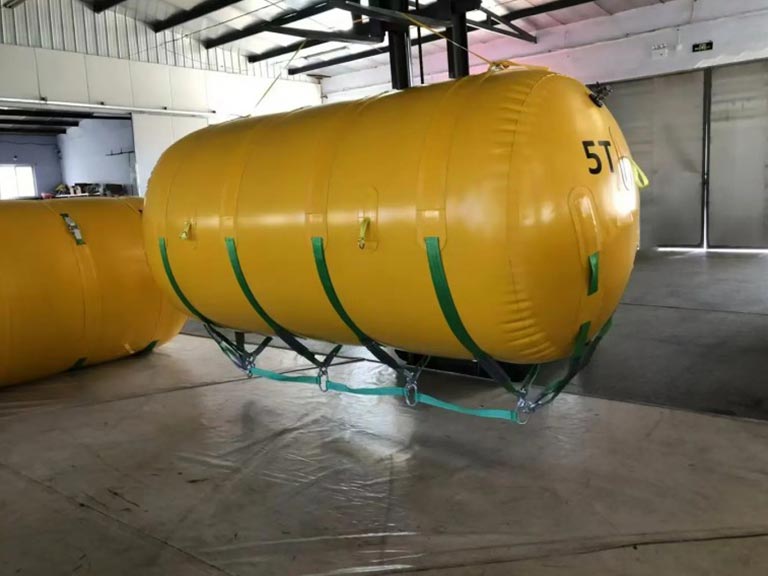
Pillow lift bags are made of high-strength PVC-coated fabric that is tear-resistant and does not absorb UV light. Each pillow lift bag includes heavy-duty webbing straps, a 3/4-inch stainless steel ball valve, and a quick connector. Pillow lift bags can reach their maximum height when the water is shallow. The pressure relief valve opens when the pressure reaches about 2.5 psi.
Pillow lift bags are also made of PVC, unlike marine rubber airbags. In addition, they can only lift a maximum of 5 tons, so they are not suitable for use on large ships.
Application Of Pillow Lift Bags
Pillow lift bags are the best way to keep objects afloat. Salvage workers can use them in any position, upright or lying down inside or outside structures. They can therefore be used to salvage boats, cars, pipes, and cables. They can also be used as emergency buoyancy for boats, aircraft, submersibles, and remotely operated vehicles.
For most small boats, rescuers can use compressed air to fill the pillow lift bags until it has sufficient buoyancy. In addition, it can also be stored inside the boat to increase buoyancy.
Steel Salvage Pontoon
Salvagers can weld steel pontoons or use 55-gallon oil drums to salvage submerged vessels. A salvage steel pontoon is a vessel that floats on the water. It is sealed on all sides and can float very high when immersed in water. This special steel salvage float consists of an air chamber and three buoyancy chambers. In addition, it has an air intake system, a drainage system, and a method for securing the mooring lines.
Relative Merits Of Steel Pontoon
Because steel is very hard, water pressure cannot bend it when it sinks to the bottom of the sea. In other words, it will not lose buoyancy due to excessive water pressure. However, they cannot be folded up like underwater lifting bags or rubber airbags. This is why it requires a lot of space to store. And it is also very costly to move.
On the other hand, its buoyancy is fixed. Therefore, it is not possible to change the buoyancy of the steel pontoon to suit the needs of the site. However, compared with other marine salvage airbags, its buoyancy is very good.
Application Of Steel Salvage Pontoon
The steel salvage pontoon is ideal for use in rescue operations involving large vessels. It can also be used in waters of any depth. The steel pontoon can help submerged vessels to float in a controlled manner. It can also be used to quickly repair harbor areas and waterways, as well as in response to sudden disasters at sea.
It is therefore one of the most important tools in emergency rescue. It can be used to bring sunken boats and other objects to the surface. Some people also use it to help stranded boats return to port and keep stranded boats afloat and stable.
Parachute Type Underwater Lift Bags
Divers and marine salvage personnel use parachute-type underwater lift bags to lift heavy objects underwater. They are teardrop-shaped and have an open or closed-bottom parachute design. These airbags include both professional airbags and commercial diving airbags.
Not only are underwater lift bags practical, but they are also important towing tools that should be used with caution. They are different from other lifting tools in that they are lifted by the upward thrust of the water being expelled when the air is filled. Therefore, this type of lifting bag should only be used with proper lifting plans and risk assessments.
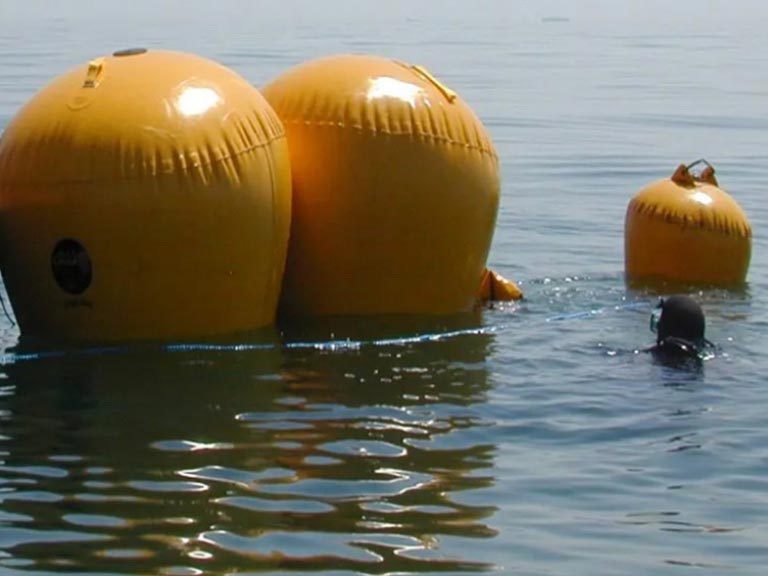
Relative Merits Of Parachute-Type Lift Bags
Because the bottom of a parachute-type lift bag is open, this means you can use it for any water-depth operation. You can use it to lift objects or wrecks from any water depth.
Parachute-type lift bags are made from PVC-coated fabric. This means that they are lightweight and easy to use. In addition, they have only one lifting point, which makes them easy to install.
Application Of Parachute Underwater Lift Bags
Generally speaking, salvage workers can use open-bottom air flotation bags at any depth to lift objects from the seabed or back to the surface. This is because the shape of the open bottom makes them safer to use. These parachute lift bags are therefore a flexible buoyancy device that can be used for a variety of purposes. In other words, they can be used for marine salvage bags, scuba diving lift bags, boat lifting and salvage, shipwreck salvage, and pontoon salvage.
Here is a list of some common uses:
- Deepwater salvage
- Ship salvage buoyancy support
- Shipwreck salvage
- Static buoyancy support
- Commercial and military use
- Subsea rigging
- Military equipment lifting
- Floating bridge supports
- Inflatable pontoons
- Extra buoyancy for pipe and cable
Conclusion
Marine salvage airbags are versatile and essential tools for the maritime industry. They are designed to meet a wide range of salvage and launching needs. Different types of marine salvage airbags have different uses. Whether it is used to salvage a wreck, assist with launching, or stabilize an underwater work structure.
Understanding the specific applications and advantages of these airbags helps professionals choose the right solution for their projects. When selected and used correctly, marine salvage airbags can improve efficiency, safety, and cost-effectiveness. If you have any questions, please contact us. Zhonghaihang has a professional service team that can solve your problems
FAQ
How do I determine the correct size of airbags for my salvage operation?
How to inspect and maintain marine salvage airbags to ensure their service life?
Are your products certified by third-party inspection bodies?
Can your airbags be used for ship launching and docking operations?
Talk to our team.
Share a few details about your project — vessel, port, or operation. We'll reply within 24 hours.