

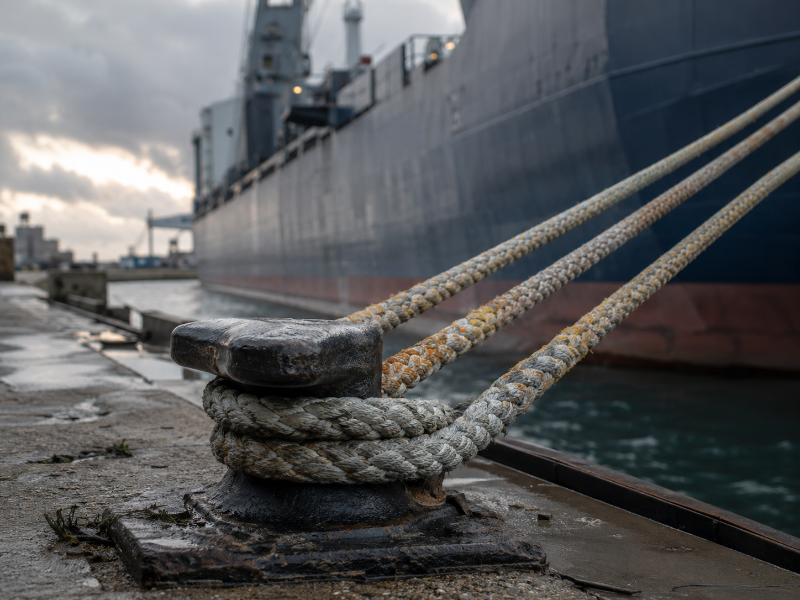
Marine mooring ropes are the synthetic or wire lines that hold a vessel at a berth. They absorb shock loads, share force across several lines, and stretch in a controlled way. Fibre, construction, diameter, and certified break force decide which rope fits a ship. The Oil Companies International Marine Forum sets that figure in its Mooring Equipment Guidelines, fourth edition (MEG4). It is the Line Design Break Force, set against the ship’s design minimum breaking load rather than a catalogue rope strength. Nylon, polyester, HMPE, and polyolefin blends each answer a different load. This guide covers ship-to-berth mooring lines. Permanent offshore station-keeping, single-point moorings, and seabed anchoring are a separate design problem.
Why Break Load Alone Does Not Specify a Mooring Line
What a mooring line has to do at a commercial berth depends on three behaviours, not on break load alone: energy absorbed, load shared with neighbouring lines, and stretch before failure. A published break load describes one sample in one test machine. Two ropes with the same figure behave differently on the same ship once stiffness differs.
Most specification errors start there. Say one station carries a stiffer line than its neighbours. Vessel movement loads that line first, and it can reach its break force while the lines beside it are still stretching. The failure looks like a rope defect.
It is a system mismatch.
MEG4 moves the specification anchor onto the ship. A line no longer qualifies because its break load looks adequate. It qualifies because its certified break force matches the number the ship’s fittings were designed around. Ask a supplier for that ship-side figure before you ask for a price. A line priced against a catalogue break load can be certified, cheap, and still wrong for the vessel.
MBLSD, LDBF, and the Hardware Envelope: Which Variables Decide First
Line specification for a commercial ship starts from the ship design minimum breaking load. Fibre, construction, and diameter all answer to that figure, whatever the berth or the budget. MEG4 uses four terms, and a purchase specification has to keep them apart. All four are forces. Certificates report them in kN or tonnes-force.
- MBLSD (Ship Design Minimum Breaking Load). The figure the ship’s fittings, supporting structure, and restraint capability were sized around.
- LDBF (Line Design Break Force). The lowest force at which a new, dry, spliced line will break in a test. MEG4 sets it at 100–105% of MBLSD. Nylon is the exception. MEG4 requires nylon lines to be tested wet and spliced, because wetted nylon never returns to its original dry strength.
- TDBF (Tail Design Break Force). MEG4 sets tails at 125–130% of MBLSD. Tails take heavier wear at terminal connections.
- WLL (Working Load Limit). The operating ceiling, given as a share of MBLSD: 50% for synthetic cordage, 55% for steel wire rope.
Two variables decide before the rest.
The first is the LDBF, and it comes from MBLSD. Get it wrong and the error runs through every later choice. No fibre and no construction will recover it.
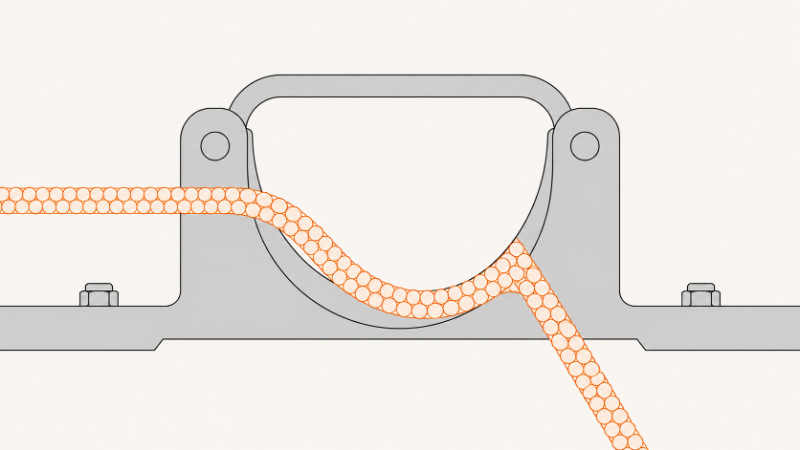
The second is the hardware envelope. It covers winch brake rendering capacity, the safe working load marked on the ship bollards and deck fittings, and the D/d bend ratio at fairleads, chocks, and drums. That hardware is fixed steel. Replacing it after delivery costs far more than buying the right rope. Length, finished ends, colour, and packaging can all change later, so they wait.
Note what this displaces. Diameter charts that map hull length to rope size were built for small craft, where displacement and windage stay in a narrow band. A ship with a high superstructure catches wind like a sail. Two ships of the same length can need different lines.
A diameter proposed without MBLSD, winch brake capacity, and fairlead geometry is a guess dressed as a quotation.
If your vessel sits on a sheltered inland berth with modest displacement and low windage, a correctly sized polyester or nylon line at commodity prices does the whole job. HMPE earns its premium only when handling weight, winch capacity, or crew safety limit the operation.
Main Types of Marine Mooring Ropes and Their Typical Uses
Fibre choice for marine mooring ropes follows the dominant load at the berth, once diameter and certified break force are held constant.
Nylon (Polyamide)
Nylon stretches more than any other common mooring fibre. That makes it the usual answer where swell, tidal surge, or passing traffic drives snatch loading. The stretch is also its limit. A line that stretches more stores more energy, and stored energy is what makes a parted line dangerous. Nylon’s wet behaviour is no footnote. It is why MEG4 certifies nylon on wet, spliced samples.
Polyester
Polyester matches nylon for strength at roughly half the stretch, and it resists ultraviolet light better. Where lines sit loaded and exposed for months, sunlight decides service life more than initial strength does. Polyester is therefore the fibre most often chosen for long-term commercial moorings. It is not a universal default. A ship’s winch system, arrangement plan, and trade can point elsewhere.
HMPE (UHMWPE, Dyneema-type fibres)
HMPE gives steel-grade strength at a fraction of the weight, with very little stretch. Light lines shorten mooring operations and keep crews safer. Low stretch also removes the shock absorption nylon provides, so HMPE main lines usually run with engineered nylon tails or mooring compensators. The fibre itself resists abrasion and fatigue well. The catch is the finished rope. An uncovered HMPE line still cuts, heats, and wears fast against rough, corroded, or sharp steel. Hardware condition, coating, and chafe protection carry that risk, not the fibre name.
Polypropylene and Polyolefin Blends
Conventional polypropylene is weaker than polyester, nylon, or HMPE at the same diameter, and it degrades faster in sunlight. It belongs in messenger lines and pick-up lines, not on a loaded station. High-tenacity polypropylene, polyolefin, and blended polyolefin-polyester ropes are a different product. Manufacturers supply and certify them as primary mooring lines where flotation, handling weight, and cost matter. The decision rests on the certified LDBF, the stiffness, and the hardware fit of the finished rope. Never on the fibre name.
| Fibre | Stretch under load | UV and abrasion behaviour | Weight / buoyancy | When to choose it, and main weakness |
|---|---|---|---|---|
| Nylon (PA) | Highest of the four | Good abrasion, moderate UV | Sinks | Surge, swell, tidal berths. Weakness: high stored energy; must be certified wet-tested |
| Polyester (PET) | Moderate, controlled | Best UV, good abrasion | Sinks | Long-term and exposed moorings. Weakness: less shock absorption than nylon |
| HMPE | Very low | Strong fibre, vulnerable uncovered on rough steel | Lightest, floats | Weight-critical and crew-limited operations. Weakness: needs tails or compensators; heat sensitive |
| Polyolefin / HT polypropylene | Moderate to high | Weaker UV, abrasion depends on construction | Floats | Flotation, handling weight, cost. Weakness: larger diameter for equal LDBF; conventional PP is not a primary line |
Stretch figures compare between suppliers only when each states the load at which it was measured, usually 10%, 20%, and 30% of certified break force. ISO 2307, the test method standard for fibre rope physical and mechanical properties (linear density, elongation, breaking force), sets that basis. A datasheet that claims “high stretch” and gives no load point cannot be compared with one that does.
Construction is a separate decision from fibre. It changes handling, inspection, and how a rope behaves under repeated loading.
| Construction | Handling and splicing | Behaviour under cyclic load | Typical use and decision guidance |
|---|---|---|---|
| 3-strand twisted | Easy to splice, stiffer in the hand | Torque unbalanced, tends to kink and cockle | Common on smaller vessels and permanent warps. Choose when on-board splicing matters |
| 8- or 12-strand plaited | Supple, holds splices well | Torque balanced, will not cockle | Common on commercial ship mooring lines. Choose when lines are handled often under load |
| Double braid (core + cover) | Softest handling, splicing needs skill | Cover protects the load-bearing core | Exposed berths with concentrated chafe. Weakness: the cover can hide core damage, so inspection and retirement criteria tighten |
Strand count is a tendency, not a rule. Performance still comes from the material, the lay length, the braid geometry, and the maker’s design.
Ask for these six items before you compare prices:
- LDBF of the finished spliced line, with the test basis stated (dry, or wet for nylon)
- Elastic stretch quoted at stated percentages of certified break force
- Linear density and specific gravity, so weight and buoyancy stay verifiable
- Minimum D/d ratio set by the manufacturer
- Temperature limit for the fibre grade and any coating
- Test standard and certificate reference, with batch traceability
Chafe, Inspection, and Retirement Criteria
Retirement of a mooring line follows the maker’s criteria and the ship’s Line Management Plan, with age, hours, load history, and station history as inputs. No single service life covers every fibre and every construction. A rope condemned by date alone may be sound. A rope kept by date alone may be dangerous.
Chafe belongs with the design variables, not with maintenance. On berths where the lead angle presses a line hard against a fairlead lip, wear gathers in a narrow band. That band can lose cross-section while the rest of the rope still looks new. A line walked along its length will pass. The same line, checked at the lead point, will not.
That check gets skipped.
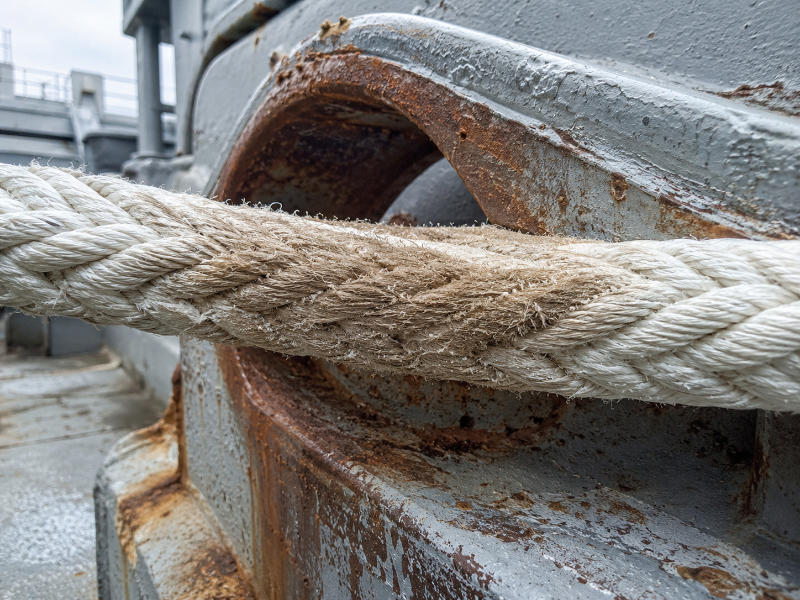
The signs are external abrasion, internal abrasion, cuts, permanent stiffness, deformation, and any trace of melting. Splices matter as much as the rope body. Melting is worth singling out. Friction hot enough to fuse filaments reports a hardware or geometry fault, not a material one. Surface fuzzing on its own retires nothing. On some fibres it is normal early wear, and the call belongs with the maker’s inspection guide and a measurement of section loss.
Rotating lines between stations can even out wear. Do it only as controlled rotation or end-for-ending, and only where the maker and the Line Management Plan allow it. After any move, re-check the length and the stiffness match with the other lines in that service. Look at where the eyes and chafe protection now sit, and whether the worn band has landed on a fresh bearing surface. Confirm that the tag and the history record moved with the rope.
None of this is a paperwork exercise. A line that parts under load releases everything it was storing, and the WLL exists to hold that energy inside safe limits. Respect the WLL, mark the snap-back zones, and keep people out of them.
Where to Start When Specifying Marine Mooring Ropes
Confirm two things before you compare quotations. The first is the Line Design Break Force your ship needs, which comes from its design minimum breaking load. The second is the hardware envelope: winch brake capacity, fitting SWL, and the D/d bend ratio the line has to work inside. Fibre, construction, diameter, and finished ends all follow, and you can adjust them without redesigning the set. Reverse the order and you spend the comparison on ropes that were never candidates.
Budget for chafe protection in the same purchase. Lines are usually condemned for a contact band a few metres long, not for wear along their length.
Bring the following to any mooring rope enquiry. Each item changes the answer:
- Vessel type, deadweight tonnage or displacement, and maximum windage profile
- Ship design minimum breaking load, and the target LDBF you are specifying against
- Berthing conditions at the intended berth: sheltered basin, tidal range, expected swell, prevailing wind
- Winch brake rendering capacity, and the SWL marked on the deck fittings
- Fairlead, chock, and drum geometry, including the minimum D/d ratio available
- Number of lines per station, whether tails are fitted, and the service each line performs
- Required length per line, and the finished ends needed: spliced eye, thimble, whipped
- Certificates and documents required, including test basis and batch traceability
Bring those eight inputs to whoever quotes your ropes. An enquiry that arrives with the ship design MBL and a photograph of the lead point gets a usable answer on the first exchange, not a diameter pulled off a chart.
Mooring lines hold a vessel off the berth. Fenders absorb the contact energy when the hull comes on. The two solve halves of the same restraint problem, and the same inputs drive both specifications: displacement, windage, berth exposure, and fitting geometry. Fenders and ship launching airbags are what Zhonghaihang manufactures. Mooring rope is not part of our range, so the checklist above is written to make your rope supplier’s answer better, not ours. If the loads at the berth are the question rather than the line itself, the same parameters start a fender conversation.
FAQ
Are wire ropes and chain still used for ship mooring?
Which certificates and documents should a mooring line come with?
What is snap-back, and does a low-recoil rope prevent it?
Can different fibres be mixed across a mooring set?
Do all mooring ropes float?
Talk to our team.
Share a few details about your project — vessel, port, or operation. We'll reply within 24 hours.