

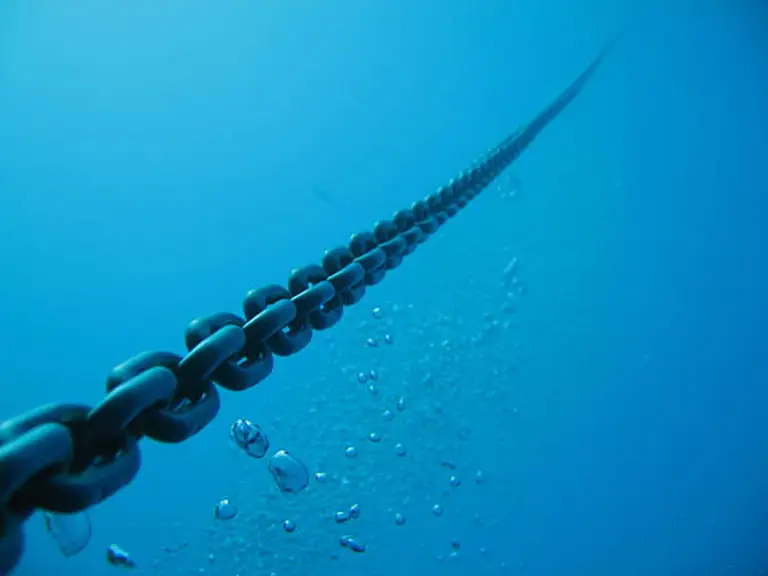
Anchor chain size is defined by the wire diameter of each link — not the outside width. Measure it with Vernier calipers, away from the welded joint, across 5-10 links, then average the result. You also need to measure pitch and internal width to confirm windlass gypsy fit.
A chain with the same nominal diameter can jam or skip if it follows a different standard. DIN 766 and ISO 4565 both make 10mm chain, but with different pitch. A BBB chain and a High Test chain in the same diameter will not fit the same gypsy.
This guide covers how to take accurate measurements, how to read chain grades, how to choose the right size for your boat, and when to replace a worn chain. If you are replacing an existing anchor chain, start with the steps below to avoid anchoring performance problems.
Understanding Anchor Chain Basics
The chain does more than connect the anchor to the boat. Its weight creates a catenary — a downward sag that keeps the pull on the anchor close to horizontal. That horizontal pull is what makes the anchor dig in and hold. A chain that is too light for the vessel loses this effect in stronger winds and currents.
Key Components
An anchor system has several parts: the anchor, the anchor rode (chain plus any rope), shackles, swivels, and the windlass. The chain portion takes the hardest punishment — dragged across rock and coral, piled in a locker, and loaded under storm conditions. The rode is only as strong as its weakest link, and that weak link is often a bargain shackle or mismatched connector.

Chain Grades and Materials
Chain grade indicates the strength class. Chain material determines corrosion behavior and cost. Both affect weight, windlass fit, and service life.
Grades
The grade number means different things in different standard systems. In metric markets, G40 corresponds roughly to the 400 MPa tensile-strength class. In North American NACM specifications, G43 is the standard High Test designation. The two serve similar roles but follow different dimensional standards — a G40 metric gypsy will not necessarily accept G43 NACM chain.
| Grade | Markings on Links | System | What to Know |
|---|---|---|---|
| G30 (BBB / Proof Coil) | G3, G30, BBB, 3B, PC | North American / general | Heaviest per unit of strength. Short link pitch fits older windlasses. |
| G40 | G40 | Metric / European (DIN, ISO) | Medium-high strength. Standard for European calibrated chain. |
| G43 (High Test / HT) | G4, G43, HT, HT4 | NACM / North American | Nearly twice the WLL of G30. Most popular current windlass chain in the US. |
| G70 (High Tensile) | G7, G70 | Transport / high-strength | Highest strength-to-weight ratio. Galvanizing can reduce strength — do not re-galvanize without the manufacturer’s guidance. |
Check the stamp on your links. “4” or “G4” means High Test. “BBB” or “3B” means G30. No stamp means unknown grade — do not trust it for anchoring.
Galvanized Steel
Galvanized chain is the standard choice. The zinc coating protects against salt water but wears off with use. G30 and G43 can be re-galvanized without losing significant strength. G70 is heat-treated steel, and the heat of a galvanizing bath can weaken it. Only re-galvanize G70 if the manufacturer confirms the process and any post-treatment needed.
Stainless Steel
Stainless chain (typically 316L) resists surface corrosion and looks good, but it is not automatically stronger than galvanized high-test chain. It is susceptible to crevice corrosion when submerged for long periods in low-oxygen conditions, making it a poor choice for boats that stay on the hook for weeks. It costs 3-5 times more than galvanized chain.
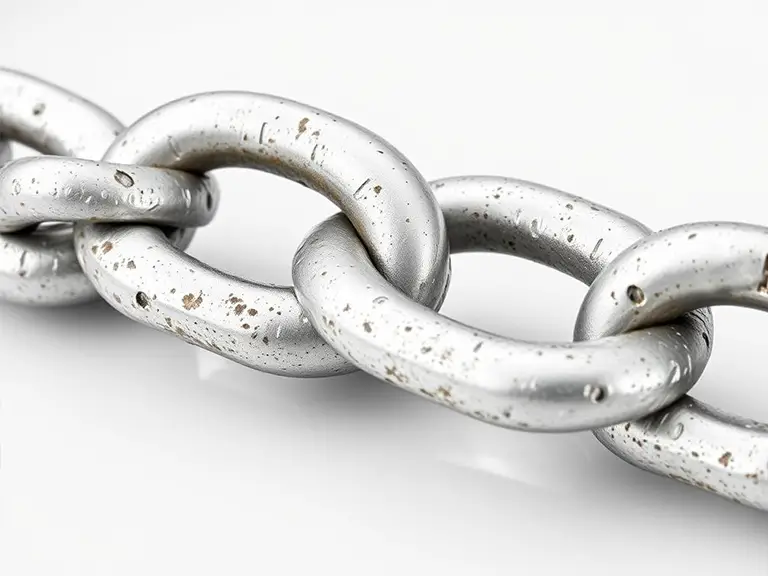
How to Measure Anchor Chain Size Step by Step
Wire diameter, pitch, and internal width — these three measurements determine whether a replacement chain will fit your windlass and match your anchoring system. Here is how to take each one.
Step 1 — Wire Diameter
This is the defining measurement. A “10mm chain” is made from 10mm wire bent into links.
Clamp the calipers around the wire on the side of the link, away from the weld. The welded joint is always slightly thicker and will give a false reading. Measure at the curve or straight section opposite the weld.
Nominal trade size and actual wire diameter are not always identical. A US 5/16″ G43 chain from Peerless/ACCO measures about 0.329″, not 0.3125″. Cross-check your reading against the manufacturer’s dimension sheet.
Step 2 — Average Over Multiple Links
A single link can be misleading. Manufacturing tolerances and wear create variation. Pick 5 to 10 links in the best-condition section of the chain, measure each one away from the weld, and take the average.
Step 3 — Pitch (Internal Link Length)
Pitch is the inside length of a link — the gap between its two inner ends. This determines whether the chain sits properly in the windlass gypsy pockets. Two chains with the same diameter but different pitch will not fit the same gypsy.
For better accuracy: lay 10 links flat, pull them tight, and measure the total length from outside edge to outside edge. Divide by 10.
Step 4 — Internal Width
The internal width is the gap between the inner sides of a link. It affects fit with shackles, swivels, and chain stoppers. Measure away from the weld joint, where the width is slightly narrower.
Step 5 — Compare with Dimension Tables
With your averaged measurements in hand, compare them to the tables below. These are typical values — actual dimensions vary by manufacturer.
DIN 766 Calibrated Chain (Metric) — Typical Values:
| Size | Wire Ø (mm) | Pitch (mm) | Internal Width (mm) | Weight (kg/m) |
|---|---|---|---|---|
| 6mm | 6.0 | 18.5 | 7.5 | 0.8 |
| 7mm | 7.0 | 22.0 | 9.0 | 1.1 |
| 8mm | 8.0 | 24.0 | 10.0 | 1.4 |
| 10mm DIN | 10.0 | 28.0 | 12.0 | 2.2 |
| 10mm ISO 4565 | 10.0 | 30.0 | 12.6 | 2.2 |
| 12mm | 12.0 | 36.0 | 15.0 | 3.2 |
| 13mm | 13.0 | 39.0 | 16.0 | 3.8 |
US G43 High Test Chain — Typical Values:
| Trade Size | Nominal (in) | Approx. Actual Wire Ø | WLL (lbs) | Break Strength (lbs) | Weight (lbs/ft) |
|---|---|---|---|---|---|
| 1/4″ | 0.250 | ~0.262 | 2,600 | 7,800 | 0.7 |
| 5/16″ | 0.3125 | ~0.329 | 3,900 | 11,700 | 1.1 |
| 3/8″ | 0.375 | ~0.394 | 5,400 | 16,200 | 1.5 |
| 1/2″ | 0.500 | ~0.525 | 9,200 | 27,600 | 2.5 |
Notes on these tables:
- 10mm DIN and 10mm ISO chain have different pitch (28mm vs 30mm). They are not interchangeable on the same gypsy. Confirm which standard your windlass uses before buying.
- G43 WLL above uses the NACM 3:1 safety factor. European manufacturers often use 4:1 or 5:1.
- These are reference values for identification. For purchases, verify against the windlass manufacturer’s spec and the chain supplier’s certified data.
Common Measurement Mistakes
Six errors cause most chain-related problems. Avoiding them saves time and money.
- Measuring on the weld:The bead is thicker than the wire. You get an oversized reading and order the wrong chain.
- Ignoring pitch:A 3/8″ BBB and a 3/8″ G43 HT have the same nominal wire diameter but different link lengths. They need different gypsy profiles.
- Measuring one link: Tolerances and wear vary link to link. Average at least five.
- Measuring the worst section: Heavily worn links do not represent the original spec. Pick a mid-rode section in decent condition.
- Confusing wire diameter with outside width: Measure the wire cross-section, not the outer dimension of the link.
- Trusting the trade size: “5/16 inch” is a nominal label. The actual wire may be 0.329″. Measure with calipers.
Choosing the Right Anchor Chain Size
The right chain diameter depends on three factors: vessel displacement, windage, and windlass gypsy compatibility. Boat length is a starting point, but displacement is the deciding factor.
Displacement and Windage
The old rule is 1/8″ of chain diameter for every 9-10 feet of boat length. But two 35-foot boats can differ by 10,000 lbs depending on hull type. A heavy trawler needs heavier chain than a light racer-cruiser of the same length. High-windage boats — tall rigs, flybridge cruisers, enclosed helms — put more load on the rode and should size up.
WLL and Safety Factors
Working Load Limit (WLL) is the maximum load for normal use, set as a fraction of breaking strength. In the US, G30 and G70 use a 4:1 factor; G43 uses 3:1. European standards typically apply 4:1 across all grades. When comparing chains from different sources, compare break strength directly, since WLL definitions vary.
Starting-Point Size Chart
This table is a guideline, not a final specification. Verify against displacement, windage, anchoring conditions, gypsy requirements, and the WLL of every connector in the system.
| Boat Length | Displacement | Suggested Diameter (G43/HT) | WLL (lbs) |
|---|---|---|---|
| Up to 20 ft (6m) | Under 4,000 lbs | 1/4″ (6mm) | 2,600 |
| 20–30 ft (6–9m) | 4,000–10,000 lbs | 5/16″ (8mm) | 3,900 |
| 30–40 ft (9–12m) | 10,000–20,000 lbs | 3/8″ (10mm) | 5,400 |
| 40–50 ft (12–15m) | 20,000–35,000 lbs | 7/16″ (12mm) | 7,200 |
| 50–60 ft (15–18m) | 35,000–60,000 lbs | 1/2″ (13mm) | 9,200 |
For boats over 60 feet, consult a naval architect or the windlass manufacturer.
Chain Length and Scope
Scope is the ratio of rode length to the vertical distance from bow roller to seabed. More scope means a more horizontal pull on the anchor, which means better holding.
Scope Formula
Required rode length = (water depth + bow roller height above water) × scope ratio
Example: 15 feet of water, 5 feet of freeboard, 7:1 scope → (15 + 5) × 7 = 140 feet.
Use the maximum depth expected during the anchoring period, including tidal rise. In calm weather, 5:1 works. Overnight in moderate conditions, 7:1. In a blow, 10:1. In crowded anchorages, use the most you can and keep an anchor watch.
Most cruising boats carry at least 300 feet of total rode, which gives 10:1 scope in 25 feet of water with 5 feet of freeboard.
Chain-to-Rope Combinations
If all-chain rode is too heavy, use at least 100 feet of chain connected to nylon line. The chain handles abrasion near the bottom and provides catenary weight. The nylon provides elasticity and saves weight.
Snubbers
On an all-chain rode, use a snubber — a nylon line hooked to the chain ahead of the bow roller. It absorbs wave and gust loads that would otherwise hit the windlass and deck hardware directly.
By understanding and applying these principles, mariners can keep their vessels securely anchored, even in rough conditions.
When to Replace Your Anchor Chain
Replace anchor chain when diameter loss reaches 10%, link elongation exceeds 5%, or visible damage appears. Here are the specific thresholds and how to inspect.
Replacement Thresholds
- 10% diameter loss. A 10mm chain worn to 9.0mm or less needs replacing. Measure in the mid-rode area, not the most worn end.
- 5% elongation. Links stretched beyond 5% of original pitch may jam in the gypsy and have reduced strength.
- Visible damage. Cracks, twisted links, missing studs, weld failures, or deep pitting all call for immediate replacement.
- Bare steel. Once the zinc is gone over large areas, corrosion accelerates. Re-galvanize (G30/G43 only) or replace.
Inspection Routine
Before each trip, give the first 30 feet a visual check. Monthly during the season, run the full rode through your hands and feel for burrs, tight links, or rough spots. Annually, lay the entire chain on deck, measure wire diameter at several points, and log the results. Comparing numbers year to year shows you how fast the chain is wearing.
There is no fixed replacement interval. Wear rate depends on anchoring frequency, bottom type, water temperature, and galvanizing quality.
Conclusion
Zhonghaihang Shipping Supply provides marine equipment solutions built to international standards. The right anchor chain starts with accurate measurement: wire diameter, pitch, internal width, and grade. Match those numbers to your windlass gypsy spec and the chain supplier’s certified data. Check every connector — shackles, swivels, and chain stoppers — to make sure nothing is undersized.
The work you put into measuring and matching pays off every time you drop the hook.
FAQ
How do I measure anchor chain size?
What is the difference between G30, G43, and G70?
How long should my anchor rode be?
When should I replace my anchor chain?
Why must chain size match the windlass?
What is the difference between DIN 766 and ISO 4565?
How does WLL relate to breaking strength?
Talk to our team.
Share a few details about your project — vessel, port, or operation. We'll reply within 24 hours.