

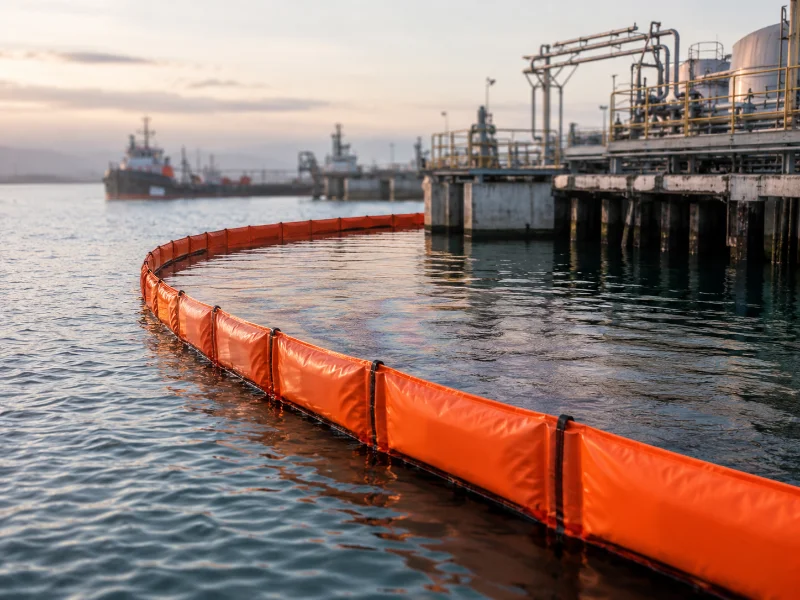
An oil spill boom is a floating barrier that contains, diverts, deflects, or excludes oil on the water surface. It does not remove oil by itself. It concentrates the slick so skimmers, sorbents, or other recovery equipment can collect it. The right boom for your site depends on the water body, the current speed, and how fast you need it deployed. This article explains what a boom does, the parts that make it work, the main types, and how to choose one.
What an Oil Spill Boom Does on the Water
An oil spill boom is a temporary floating barrier that concentrates spilled oil, and its performance depends on wave height, current speed, and how well it is anchored. A boom holds oil in a thicker surface layer instead of soaking it up. Skimmers or sorbents then work that layer. This matters because a thin slick spread across open water is far harder to recover than one held in a tight pocket.
A boom can be moored to a fixed structure, such as a pier or one of the buoys that ring a harbor. It can also be towed by tugboats and other vessels. The method depends on whether the boom needs to hold position or sweep oil toward a recovery point.
Booms serve four working roles, and the role you need shapes how the boom is set. Containment holds oil in place for on-site recovery. Diversion steers oil toward a collection point. Deflection pushes oil away from an area without recovering it. Exclusion seals off a sensitive site, such as a marsh intake, so oil never reaches it. The configuration you choose depends on current direction and wind, so one boom can do different jobs on different days.
Why a Boom Contains Oil but Cannot Clean It Up
A containment boom holds and concentrates oil on the surface, but recovery needs separate equipment such as skimmers or sorbent material. On its own, a boom does not clean a spill. This is the most common misconception in spill planning. Buyers assume a longer boom means a faster cleanup, when the boom only sets up the recovery step that follows.
Booms also have a limited operating window, and that is where containment quietly fails. The U.S. EPA notes that most booms stop performing well once waves pass about one meter or currents pass about one knot. The exact limit depends on boom design, deployment angle, oil type, and site conditions. Above those thresholds, oil rides over the freeboard or slips under the skirt. In fast-moving water, the skirt usually gives way first, folding under the current and letting oil pass beneath it. A boom planned without checking these limits against real conditions can end up containing very little.
The Core Components of an Oil Containment Boom
Every containment boom shares four structural parts, and each one maps to a failure risk you can check before you buy. Designs vary, but the anatomy stays the same:
- Freeboard — the part above the waterline that blocks oil from splashing over the top. Too little freeboard for the local waves lets oil escape over the barrier.
- Skirt (draft) — the part below the surface that stops oil from slipping underneath. A shallow skirt in strong current lets oil pass beneath the boom.
- Flotation — foam, air chambers, or solid floats that keep the boom upright and buoyant. The flotation type sets the buoyancy-to-weight ratio, which drives how the boom rides in chop.
- Ballast and tension member — a chain or cable along the bottom that weights the boom and carries wind and wave load. It works on the same load principle as a sized marine anchor chain. Without enough tensile strength, a boom stretched across a channel can part under current.
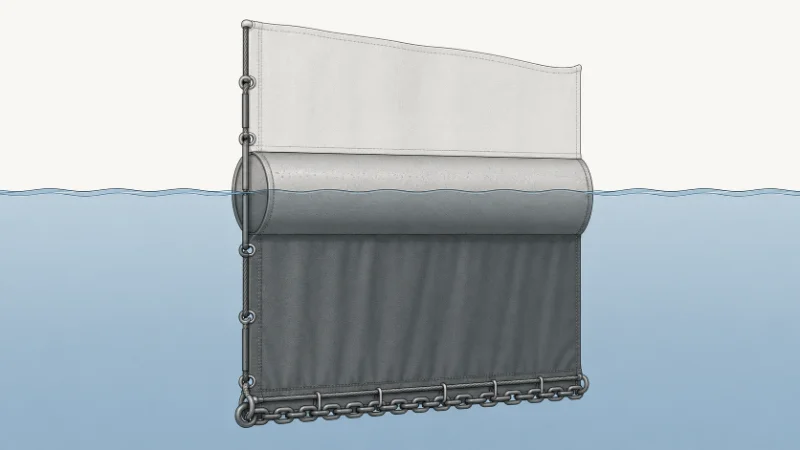
Read a spec sheet as a ratio, not just a height. Compare freeboard, draft, buoyancy, and total height together. A boom built for open water carries a very different balance than one built for a sheltered marina. ASTM F1523 is the formal reference for minimum boom dimensions by water class. ASTM F818 sets the standard terminology for these parts.
The Main Types of Oil Booms and Their Typical Uses
Oil booms fall into a handful of main types, and each one suits a specific water condition and spill scenario. The right pick depends on where the boom sits, how rough the water gets, and whether you need containment or absorption. The table compares the common types on the factors that drive the choice.
| Boom type | Construction | Best water conditions | Key limitation |
|---|---|---|---|
| Curtain (solid flotation) | Foam floats in UV-stabilized PVC | Protected to moderately exposed water | Bulkier to store; wave-following depends on buoyancy-to-weight ratio |
| Fence | Flat rigid floats with chain ballast | Calm, low-current inshore water, marinas | Lower stability; struggles once current builds |
| Inflatable / self-inflating | Air chambers filled by compression or coil | Rapid emergency deployment; rougher water | Puncture risk; chambers need maintenance |
| Shore-sealing / beach | Water-filled ballast chambers replace the skirt | Tidal flats, marshes, shoreline edges | Needs site-specific tidal-range planning |
| Sorbent (absorbent) | Polypropylene sorbent core, no skirt | Small leaks, final sheen polishing | Saturates and must be replaced; weak containment |
| Fire | Fire-resistant or water-cooled build | In-situ burning of contained oil | Fresh oil and calm weather only |
Curtain and Fence Booms
Curtain and fence booms are the two workhorses of routine containment, and the split between them comes down to water energy. Curtain booms use rounded foam flotation, which follows waves better and stays more stable in exposed water. Their fit for open-water chop still depends on buoyancy-to-weight ratio, flexibility, connector strength, and the rated wave and current class. Fence booms use a flat, rigid float and suit calm inshore water. Their flat profile winds onto a reel for quick storage and deployment.
Shore-Sealing, Inflatable, and Fire Booms
Shore-sealing, inflatable, and fire booms each handle a condition the standard curtain boom cannot. A shore-sealing boom swaps the skirt for water-filled ballast chambers. It rests and seals against exposed ground at low tide, which suits tidal flats, marshes, and shoreline edges. Inflatable booms carry a high buoyancy-to-weight ratio and stage well for fast emergency release in rougher water. Fire booms survive in-situ burning. They hold fresh oil together long enough to ignite, and they only work when the oil is fresh and the water is calm.
Sorbent Booms
A sorbent boom absorbs oil instead of damming it. Its oleophilic, hydrophobic core soaks up hydrocarbons while shedding water. Because it has no skirt, a sorbent boom cannot hold oil for long. It works best as a backup line, catching sheen inside a containment ring or around machinery. Once the core saturates, you retrieve and replace it.
Choosing a Boom by Water Condition and ASTM Guidance
Boom selection starts with the water body, and the decision variables are wave height, current speed, and how long the boom must stay on station. ASTM International publishes standards for exactly this call. F625 classifies water bodies for spill control. F1523 guides boom selection against those classes. Working from the water class down to the boom beats matching a boom to a loose label like “the harbor.”
The matrix below maps common water conditions to a boom type and the one variable most worth checking before you buy:
| Water condition | Suitable boom type | Key variable to verify | Avoid |
|---|---|---|---|
| Calm marina or pond | Fence or light curtain | Freeboard, connector, storage reel | Oversized offshore boom |
| Harbor or terminal | Curtain | Total height, tensile strength, UV resistance | Sorbent-only setup |
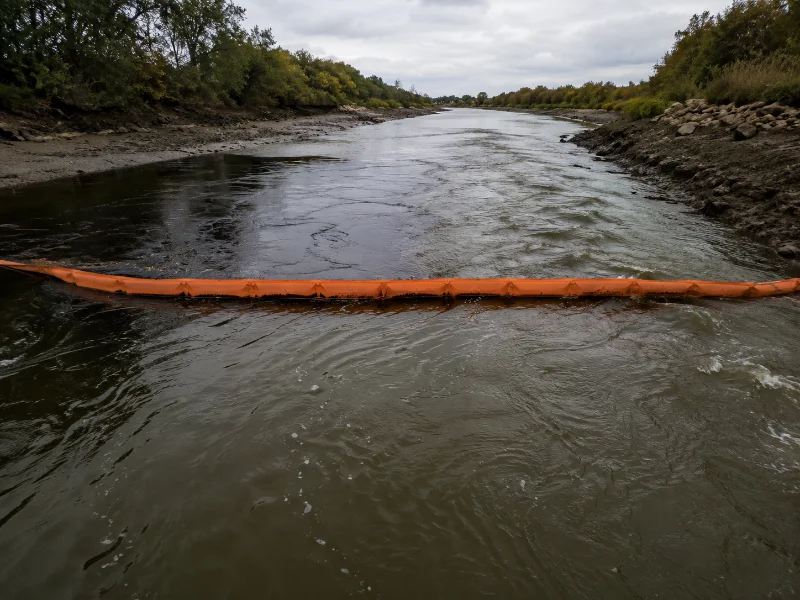
| River or tidal channel | High-tensile curtain or inflatable | Current rating, deployment angle | Light fence boom |
| Offshore or exposed water | Inflatable or high-buoyancy curtain | Buoyancy-to-weight ratio, wave rating | Low-freeboard boom |
| Shoreline or tidal flat | Shore-sealing | Grounding behavior, tidal range | Standard deep-skirt boom |
| Final sheen control | Sorbent | Absorption capacity, replacement plan | Treating it as containment |
| In-situ burn | Fire | Heat rating, oil freshness, weather | Routine harbor use |
Several ASTM standards let you test a spec sheet against a named method instead of a marketing claim:
| Standard | What it covers | Ties to |
|---|---|---|
| ASTM F625 | Classifies water bodies for spill control | Matching boom to site |
| ASTM F1523 | Boom selection by water body class; minimum dimensions | Freeboard, draft, total height |
| ASTM F2683 | General selection of booms for oil-spill response | Type-vs-category choice |
| ASTM F2682 | Buoyancy-to-weight ratio determination | Wave-following stability |
| ASTM F1093 | Tensile strength test methods | Channel crossing, towing loads |
| ASTM F962 | Z-connector specification | Section-to-section compatibility |
In practice, the trouble comes from choosing on price instead of water class. A light fence boom is cheap and fine for a sheltered marina. Put the same boom in a tidal channel, and it submerges and loses oil under the skirt once the current builds. The check is simple. Match the boom’s rated wave height and current to the site’s worst realistic conditions, not its calm-day average.
One boundary is worth naming. The mooring and anchor layout that holds a boom against a current is a separate engineering task. Engineers size it from a site survey and load calculations, apart from boom selection. Choosing the boom type and specifying the mooring that keeps it in place are two different decisions. Treating them as one is a common planning error.
Common Boom Failure Modes on Site
Boom failures follow a few recurring patterns, and each one traces back to a mismatch between the boom and the day’s conditions. Knowing these modes before you deploy helps more than any single spec number:
- Submergence — current or an undersized skirt pulls the boom under, and oil escapes below as droplets rising behind the line.
- Splash-over — waves top the freeboard and send oil over the barrier.
- Twisting and dipping — the boom sits at the wrong angle to the current, which breaks the seal at the waterline.
- Parting — tension across a span passes the tension member’s rating, and sections break apart.
Boom performance should be observed, not assumed. Set a boom without checking current speed against the water class, and the usual result is submergence. You then re-tension it under pressure, mid-response, when the fix is hardest. Monitoring matters most for stationary, moored booms. Shifting tides and winds change the load through the day, and they can quietly defeat a boom that looked secure at slack water. The 2010 Deepwater Horizon response showed both the reach and the limits of boom. Millions of feet were deployed, yet wave height, current, deployment quality, and monitoring still limited performance.
Matching the Right Boom to Your Water and Spill
Boom choice comes down to three linked variables: the water class, the worst realistic wave height and current, and the job you need. Get those right, and the freeboard, skirt depth, and boom type follow. Get them wrong, and even a long, costly boom line can submerge, splash over, or part when it matters most.
Most boom shortfalls trace back to one mismatch: the boom’s freeboard against the actual wave height on the day. A defect in the boom is rarely the cause. As a marine equipment supplier, our team starts from a site’s water class and current data. We then specify the boom type and the freeboard-to-height balance for those conditions. The mooring design stays a separate item that needs its own project-level confirmation.
Planning spill readiness for a port, terminal, or vessel? Start by documenting four things: your water type (harbor, river, offshore, or tidal flat), your worst-case current and wave height, the oil or fuel you handle, and your required response time. With those inputs, we can match a boom type and specification to your site and confirm the details that depend on your conditions.
FAQ
What are the main types of oil booms?
How do oil containment booms work?
What is the difference between a curtain boom and a fence boom?
Can oil booms be used in rivers and offshore?
What is the difference between a containment boom and a berm?
What are the disadvantages of oil spill booms?
Talk to our team.
Share a few details about your project — vessel, port, or operation. We'll reply within 24 hours.