


Ship mooring methods are the practical ways a vessel is restrained at a berth, buoy, offshore terminal, or alongside another ship. These systems must withstand wind, current, and wave loads. At Zhonghaihang Shipping Supply, we provide marine equipment solutions for mooring operations requiring exposure risk management. We supply pneumatic and rubber fenders used at berths and during ship-to-ship transfers.
This article focuses on common mooring methods and how to choose the right one based on the scenario. A mooring method is more than just a name. The same vessel requires different setups depending on berth geometry and heading control needs. We explain what each method controls, its limitations, and what to check before committing to a setup.
Ship mooring basics that shape line layout and vessel control
Choosing a mooring method depends on how lines restrain vessel motion along and across the berth. It also depends on how they limit yaw under changing environmental forces. Most setups combine longitudinal restraint, lateral restraint, and rotation control. We focus on the function and logic of the configuration rather than numerical design.
A mooring arrangement is easier to understand when you separate line roles by what they control. Head and stern lines primarily limit fore-and-aft movement. Breast lines resist lateral movement toward or away from the berth. Spring lines stabilize the vessel’s position along the berth and reduce surging caused by wind gusts or passing traffic.
Learn More: What Is A Mooring Line?
Environmental forces act continuously. Wind creates sustained lateral loads and yaw moments. Currents can pull the vessel off the berth or push it along the quay. Waves drive cyclic motions that fatigue equipment and crew. We treat the mooring method as a way to distribute the restraint so no single line group carries the entire load.
Safe mooring relies on disciplined communication and predictable line handling zones. Crews should treat snapback areas, line leads, and fairlead conditions as part of the total system. Monitoring weather and traffic is also vital. Changes in wind direction or passing vessel effects can quickly shift the dominant restraint direction.
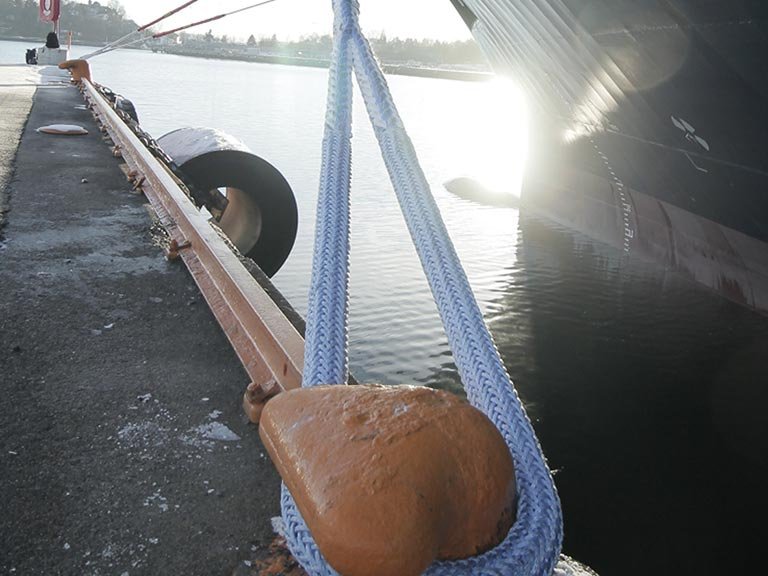
Main ship mooring methods and their typical uses by scenario
Compare mooring methods by where they are used and what motion they control. We group these methods by scenario so you can match the operation to a practical restraint concept.
Alongside mooring at berth or jetty for routine port calls
Alongside mooring is used when a vessel lies parallel to a quay or jetty. Lines lead to bollards, dolphins, or mooring hooks. This method is standard for routine port calls because it supports loading, discharging, and safe access.
It works best when line leads allow balanced restraint without extreme angles. It becomes challenging when strong currents run along the quay or wind pushes the vessel off the berth. Fendering is the first line of defense against contact risk during approach, surge, or passing ship effects.
Mediterranean mooring for stern-to-jetty berths
Mediterranean mooring is common where berth space is restricted. The vessel positions stern-to-jetty to save quay length. A combination of anchors and stern lines holds the ship in place.
This method is sensitive to anchoring conditions and alignment. The vessel must maintain position between the jetty face and the anchor restraints. It is less forgiving if wind or current shifts across the vessel. Fendering planning focuses on stern contact zones and potential side contact during alignment.
Baltic mooring for constrained maneuvering areas
Baltic mooring is used when a bow-in position is required. Anchors provide offshore restraint while shore lines provide berth-side restraint. This is often selected when maneuvering room is limited, and a controlled approach to a fixed berth is needed.
Success depends on anchor reliability and consistent line handling. The vessel’s position relies on balancing shore lines against the anchor. While good for quick departures, it requires a suitable seabed. Contact risk concentrates at the bow near the quay, making fender placement critical there.
Single Point Mooring (SPM) for offshore loading
Single-point mooring supports offshore loading where the vessel must align with changing wind and current. The vessel weathervanes around the mooring point, reducing side-load risks when conditions shift.
SPM performance depends on the mooring point system and operational limits. It reduces the need for a fixed heading but requires monitoring of environmental changes. We separate the benefit of weathervaning from transfer safety; cargo operations still rely on stable control.

Multi-Buoy Mooring (MBM) for fixed heading control
Multi-buoy mooring holds a vessel in a specific orientation. It is used in terminals or deep water where berths are unavailable. Multiple mooring points resist rotation and keep the vessel aligned with hoses or loading arms.
MBM requires coordinated line handling and reliable buoys. Small alignment errors can disrupt operations. It works well in sheltered waters but is sensitive to environmental changes that create unbalanced loading. Verification focuses on approach planning and maintaining line geometry.
Ship-to-Ship (STS) mooring for offshore transfer
Ship-to-ship mooring transfers cargo between two vessels. The challenge is managing relative motion between two floating bodies. This increases contact risk and makes fendering central to safety.
STS operations rely on specialized fenders to absorb energy and maintain separation. Pneumatic fenders are common because they manage contact energy and accommodate relative motion better than standard rubber fenders. The choice depends on scenario constraints and the expected contact interface.
Trade-offs that separate similar mooring methods
Evaluate trade-offs by what the method allows the vessel to do when conditions change. Do not simply rank them as “better” or “worse.”
Alongside and Baltic layouts both support berth operations. However, they differ in how they handle longitudinal forces and distribute restraint between shore fittings and anchors. Mediterranean mooring saves berth length but relies heavily on anchoring conditions. Offshore buoy methods remove the need for fixed structures but introduce verification and monitoring requirements.
Single point mooring and multi-buoy mooring differ by heading freedom. SPM allows rotation with the environment, while MBM controls orientation. Heading freedom reduces certain loads but complicates transfer alignment. Fixed heading control simplifies alignment but increases sensitivity to directional changes.
STS mooring shares line-handling concepts with alongside mooring, but the risk profile is different. The “berth face” is another moving vessel. The priority is managing relative motion, contact energy, and safe separation. We treat fendering as a decisive constraint in STS operations.
Learn More: What Is A Mooring?

What to verify before selecting or adjusting a ship mooring method
Selection is only defensible when site and operational conditions are verified. Check for changing conditions like wind shifts, current sets, and wave patterns. Also, verify fixed constraints like berth geometry and fitting conditions.
Verification is best structured as a short set of checks tied to failure modes. Confirm if the method can control the required motion and if line leads are feasible.
Pre-selection verification points for common mooring methods
Verification point | Why it matters | Typical methods most sensitive |
|---|---|---|
Expected dominant load direction | Determines which line groups provide primary restraint | Alongside, Baltic, MBM |
Berth geometry and mooring points | Poor lead angles cause load concentration | Alongside, Baltic |
Seabed suitability for anchoring | Anchor reliability is a constraint, not an assumption | Mediterranean, Baltic |
Fixed heading vs weathervaning | Drives choice between orientation control and freedom | SPM, MBM |
Contact interface and zones | Dictates fendering plan and monitoring focus | Alongside, STS, Mediterranean |
Operational window | Changing conditions can invalidate a setup mid-operation | SPM, MBM, STS |
Do not overlook fendering verification. Check where contact is likely during approach, surge, and environmental shifts. Ensure the arrangement matches the contact geometry. For STS, verify fender condition and placement as part of the core control plan.
Confirm communication and coordination. Bridge and deck teams must share the plan. Clear line handling zones and monitoring responsibilities reduce the chance of unsafe execution drift.

Conclusion
Treat ship mooring methods as scenario-driven strategies, not fixed recipes. Select a method by matching the operation to what must be controlled. Compare trade-offs like heading freedom versus fixed alignment, and verify site conditions that might invalidate your choice.
At Zhonghaihang Shipping Supply, we support operations where berth or ship-to-ship contact risk must be managed. We use pneumatic fenders and rubber fenders as part of the contact management plan. Verify contact zones, method constraints, and monitoring capability before execution. A method that fits the scenario and passes verification is always more reliable than one chosen for familiarity.
FAQ
What forces matter most when comparing ship mooring methods?
How do I choose between single point mooring and multi-buoy mooring?
When is Mediterranean mooring used instead of standard alongside mooring?
Why is mixed mooring considered risky?
What role do fenders play in ship-to-ship mooring safety?
What should be verified before committing to an alongside mooring?
Talk to our team.
Share a few details about your project — vessel, port, or operation. We'll reply within 24 hours.