

As a leading provider of marine equipment solutions, Zhonghaihang Shipping Supply is frequently questioned about the materials used in its products. One often asked topic is whether vulcanized rubber airbags contain talcum powder. Given the importance of these airbags in ship launching, landing, and salvage operations, this is a vital question.
Ship launching airbags, also known as rolling airbags or inflatable marine airbags, are intended to be durable and dependable. They are made of heavy-duty synthetic tire cord layers and inner and outer rubber layers, resulting in a long, cylindrical airbag. Understanding the production process and materials utilized in these airbags is critical to guaranteeing the safety and reliability of maritime operations.
Understanding the Vulcanized Rubber Airbags
Ship launching airbags are vulcanized rubber goods made exclusively for ship launching and upgrading. Vulcanized rubber airbags revolutionized the marine industry with their novel method of launching ships. Suppose you wish to avoid the issues associated with end-to-end drainage, side-to-end drainage, and floating drainage. Then, these rubber airbags are an excellent choice.
Their spherical balloon shape with conical tips makes them suitable for smooth rolling during ship launches. Using vulcanized rubber airbags has numerous advantages. These include time and cost savings, flexibility, and increased safety.
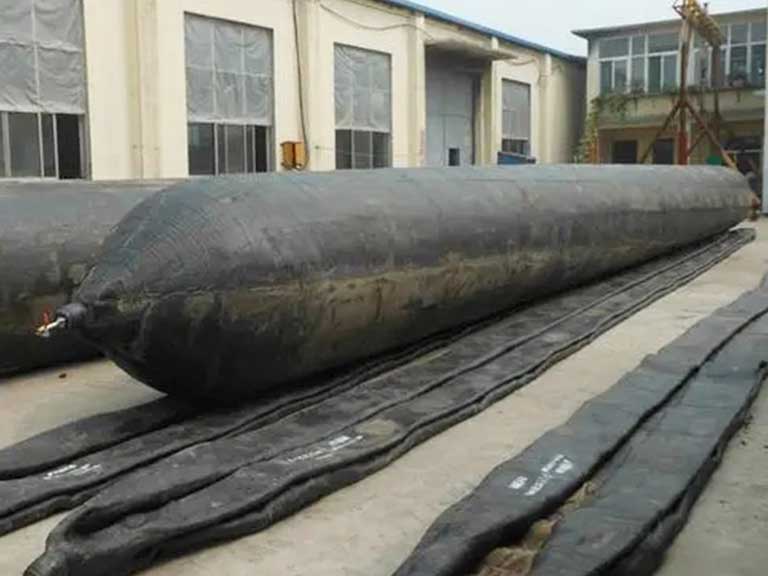
What Vulcanization Does For Airbags
The vulcanization process converts raw rubber into a strong and elastic material. This increases its strength and elasticity. This technique is critical for giving airbags the desired characteristics. As a result, they can resist strong pressure and enormous loads while launching ships.
Vulcanized rubber airbags are a versatile and efficient means for constructors to launch ships. This approach is gaining popularity worldwide due to its effectiveness and dependability.
The Use of Talcum Powder in Vulcanized Rubber Airbags
French chalk is another name for talcum powder. It is utilized in the vulcanization of rubber airbags for scientific reasons. Talcum powder is used as a releasing agent in the vulcanization process. This prevents the rubber surfaces of our airbags from adhering when heated and squeezed together.
- Why Talcum Powder Is Used: We use talcum powder to maintain our vulcanized rubber airbags working properly. Talcum powder aids in the correct curing of the rubber by preventing the layers from sticking together. This ensures that the final product is of good quality.
- The Vulcanization Process and Powder Application: The rubber mix is heated and pressed under high pressure during the vulcanization process. We applied talcum powder to the rubber surfaces to prevent them from adhering. This use is critical for manufacturing ship launching airbags and other types of rubber airbags.
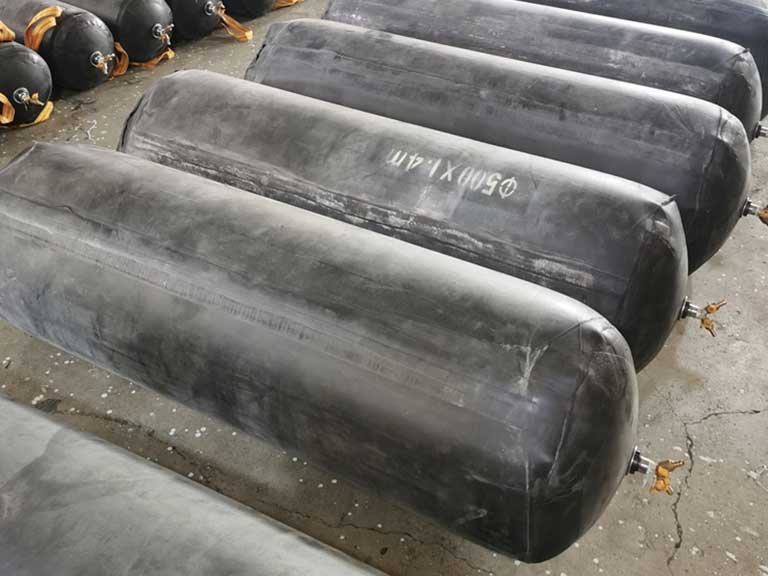
- Common Mistakes About Powder Residue: Many individuals believe that new vulcanized rubber airbags appear dirty or used. This is because they are coated with talcum powder. The French chalk and water mist in the vulcanization tank, leaving behind a layer that may make new airbags appear unclean. This dust has no effect on the performance or quality of our vulcanized rubber airbags.
Customers should search for damage or deformation on their airbags to distinguish between typical production residue and indicators of actual use or wear. There is no need to be concerned about regular dust hurting the airbags.
Construction and Materials for Vulcanized Rubber Airbags
Zhonghaihang Shipping Supply’s vulcanized rubber airbags have a sturdy, multi-layer design, making them durable and dependable. This design is critical for ensuring that the rubber airbags can withstand the harsh conditions of the ocean and the stress of launching a ship.
- Outer Rubber Layer Specifications: The top layer of rubber is designed with specific tension and tear strengths to guard against wear and tear and external forces. It is critical that this covering protects the inside of the airbag from damage.
- Synthetic-Tire-Cord Reinforcement Layers: The layers of synthetic tire cord reinforcement are composed of rubber-coated synthetic tire cable textiles. Our innovative “Holistic Wrapping Technology” twists these layers together at the appropriate angles.
- Inner Rubber Layer Properties: The inner rubber layer’s purpose is to maintain constant air pressure while also providing structural support to the airbag. This layer, along with the top and support layers, ensures that the airbag performs properly and lasts a long time.
Our vulcanized rubber airbags are composed of numerous layers. This makes them sturdy enough to withstand severe internal pressures. Furthermore, they can distribute tension during ship launch. Extra strengthening layers are added to the end shoulders to increase the structure’s strength in high-stress locations.
Types of Vulcanized Rubber Airbags
We offer three highly effective boat launch airbags to fulfill the needs of varied boat launches. We may give customized options to meet a variety of needs. This ensures that your ship’s launch mission is successful.
- QP (General Purpose): For medium cargoes, most ships use 3-5 layers of curtain design.
- QG (High Load Type): With 6-8 layers of cord fabric, it is ideal for heavy-duty ship launches and has a larger load carrying capacity.
- QS (Ultra High Load Type): Designed for extremely heavy loads, with 9 or more layers of curtain fabric. Maintains stability even under the most extreme stresses.
The number of layers in synthetic tire cord is directly proportional to the safe working pressure and overall load capacity of each type of airbag. We can supply customized specifications that go beyond the typical product range based on customer needs. This can suit clients’ specific application requirements.

Applications for Vulcanized Rubber Airbags
We use vulcanized rubber airbags in a number of nautical and commercial applications to demonstrate their utility and flexibility. These airbags are mostly employed during ship launches and conversions. This suggests that they can manage ships of all shapes and sizes.
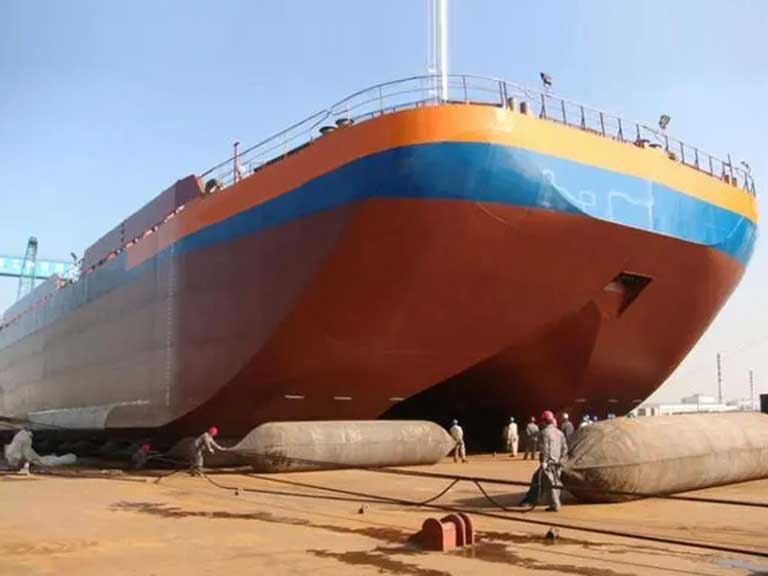
- Ship Launching and Upgrades: Vulcanized rubber airbags are most commonly used to launch ships. Our ship launching rubber airbags have been utilized to securely launch barges, chemical tankers, tugboats, AHTS vessels, floating docks, and even caisson construction. The largest ship ever launched using this technology weighed up to 100,000 DWT.
- Marine Salvage Operations: People use vulcanized rubber airbags to refloat stalled ships, recover wrecked ships, and complete underwater recovery missions. They are capable of handling challenging underwater jobs because of their flexibility and adaptability.
- Heavy Lifting Applications: Our airbags are useful for more than merely launching ships. They are also used for heavy lifting, such as moving large buildings and concrete caissons, and can lift over 1,000 tons each.
In addition, it can be used to install buoyancy on pipeline float-outs, beach pulls, river crossings, lowering vessel and platform drafts, and sustaining floating bridges. Vulcanized rubber airbags are ideal for a variety of marine and industrial applications due to their flexibility.
Conclusion
Selecting the appropriate vulcanized rubber airbag is critical to guaranteeing smooth offshore operations. We would like to reiterate that talcum powder is utilized to create vulcanized rubber airbags. This is a standard procedure for ensuring product quality.
Zhonghaihang Shipping Supply adheres to stringent quality standards and offers suitable certification for our rubber airbags. It is critical to get high-quality airbags with the appropriate pressure and carrying capacity. When utilized correctly, an airbag can last 5 to 8 years.
Customers are invited to consult with our expert team to determine the best sort of airbag for their needs. We have been in business for many years and provide excellent products and customer service.
FAQ
How much weight can Ship-Launching Airbags support?
Do the international standards for marine airbags meet your needs?
What materials do you use to make your airbags?
Can Your Airbags Be Used to Rescue People from Water?
How Do I Determine the Size and Type of Airbag I Need for My Ship Launching Business?
Talk to our team.
Share a few details about your project — vessel, port, or operation. We'll reply within 24 hours.