

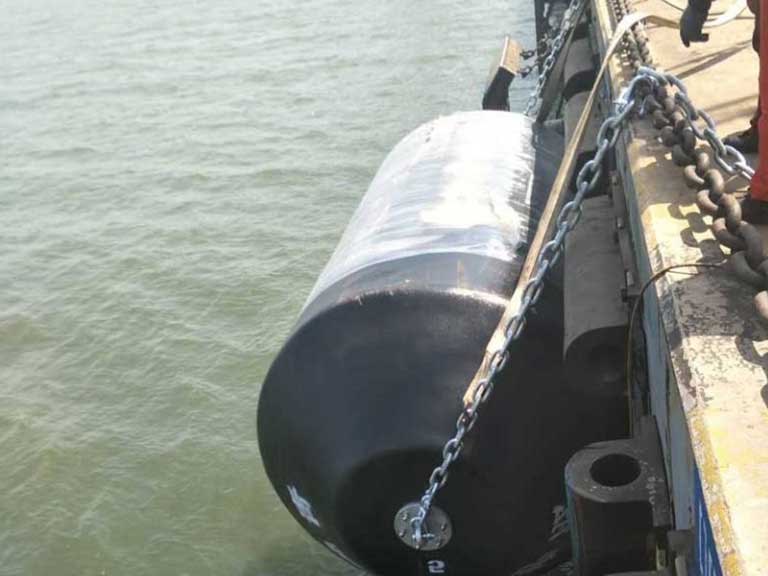
A foam filled fenders is a marine protective device that uses a solid closed-cell foam core to absorb berthing energy. It protects vessels, docks, and offshore platforms from collision damage during mooring and docking operations.
Unlike pneumatic fenders, foam fenders cannot be punctured or deflated. Even if the outer skin is cut or torn, the closed-cell foam core maintains buoyancy and continues to function. This makes foam fenders one of the most reliable protection systems in the maritime industry.
How a Foam Fender Is Built
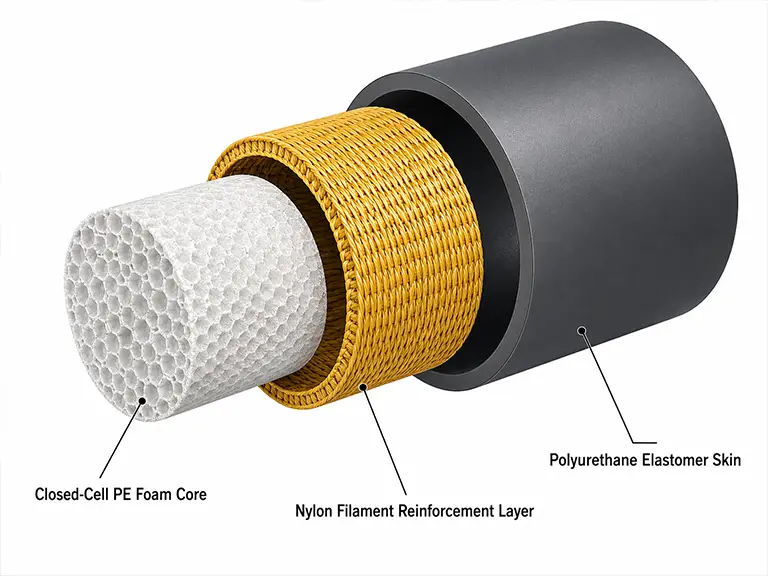
Every foam fender consists of three layers. Each layer serves a specific engineering purpose.
Foam Core
The core is made of closed-cell polyethylene (PE) or EVA foam. Individual foam blocks are thermally laminated together under heat and pressure to form a single solid body. This process eliminates internal air gaps and creates a uniform energy-absorbing structure.
The closed-cell structure means each foam cell is sealed independently. Water cannot migrate through the core even if the outer skin is breached. Core density typically ranges from 58 to 70 kg/m³. Higher-density foam provides greater energy absorption but increases overall weight.
At Zhonghaihang, our foam cores are manufactured using precision thermal lamination. Each core undergoes compression testing before skin application to verify energy absorption meets design specifications.
Reinforcement Fiber Layer
A layer of high-strength nylon filament is embedded between the foam core and the outer skin. This reinforcement provides structural integrity and prevents the skin from separating under repeated impact.
Standard reinforcement uses 2520-denier nylon fiber with a tensile strength of ≥230 N. For extreme-duty applications, Kevlar™ reinforcement is available.
Outer Skin
The outer layer is a spray-applied polyurethane elastomer coating. It protects the foam core from UV radiation, saltwater, chemical exposure, and mechanical abrasion.
Key skin specifications include a hardness of 75–95 Shore A, tear resistance greater than 52 N/mm, and an operating temperature range of -40°C to +60°C. The non-marking surface prevents paint transfer to vessel hulls — a critical requirement for cruise ships and naval vessels.
Performance Characteristics
Foam fenders are designed to compress up to 60% of their original diameter while absorbing berthing energy. After compression, a properly manufactured fender rebounds to at least 90% of its original diameter within 24 hours.
Energy Absorption and Reaction Force
Foam fenders deliver high energy absorption with relatively low reaction force. A 2-meter diameter fender can absorb between 100 and 500 kNm depending on length and foam density. Reaction forces are typically 20–30% lower than comparable rubber fender systems.
This combination matters for port engineers. Lower reaction force means less stress on the berth structure. Higher energy absorption means better vessel protection. The result is reduced maintenance costs for both the dock and the ship.
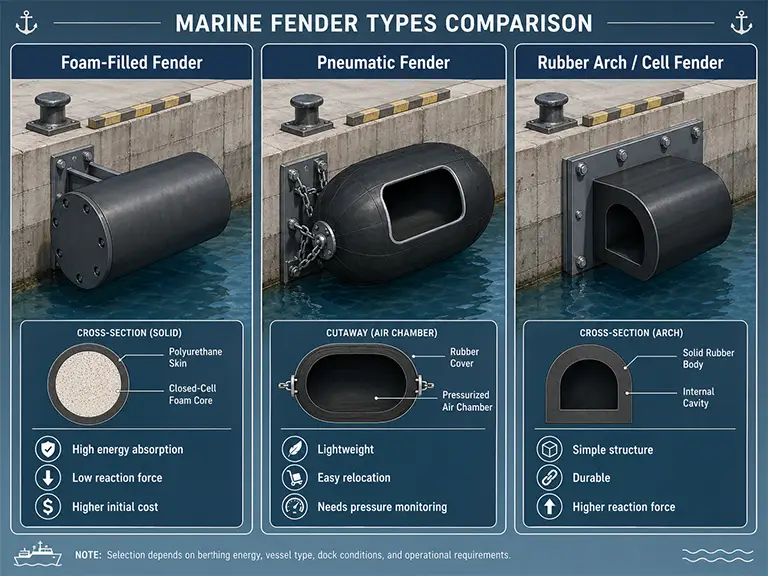
Performance Comparison: Foam vs. Pneumatic vs. Rubber
| Feature | Foam Fender | Pneumatic Fender | Rubber Fender |
|---|---|---|---|
| Energy absorption | High | High | Medium to High |
| Reaction force | Low | Low | Medium to High |
| Puncture risk | None (solid core) | Yes (air-filled) | None (solid) |
| Maintenance | Minimal | Regular pressure checks | Minimal |
| Weight | Medium | Light | Heavy |
| Best for | Fixed berths, tidal ports, cruise terminals | STS transfers, curved hulls | Fixed dock walls, high-frequency berths |
| Hull marking | Non-marking | Non-marking | May mark hulls |
| Buoyancy if damaged | Maintained | Lost if punctured | Sinks |
Each fender type has its optimal application. Foam fenders excel at fixed berths with large tidal ranges, cruise and naval terminals requiring non-marking contact, and offshore platforms needing maintenance-free protection. Pneumatic fenders remain the preferred choice for ship-to-ship (STS) transfer operations where hull curvature adaptation is critical. Rubber fenders are cost-effective for high-frequency general cargo berths.
Zhonghaihang manufactures all three fender types. Our engineering team can recommend the right solution based on your vessel size, berth configuration, and operating conditions. Contact us for a detailed fender selection analysis.
Industry Standards and Testing
Foam fender design and testing follow established international standards.
- PIANC WG211 (2024): The World Association for Waterborne Transport Infrastructure published updated guidelines for fender system design. These cover energy absorption calculation, reaction force limits, and testing protocols. PIANC recommends hull pressure below 200 kN/m² for most vessel types.
- ASTM F2192: Standard test method for determining berthing energy and reaction force. This defines how compression tests must be conducted and reported.
- ASTM D2240: Standard for measuring polyurethane hardness (Shore A durometer).
- US Navy specifications: Military-grade foam fenders are manufactured to UFGS 35 59 13.17 requirements. These specify minimum energy absorption at 60% compression, 24-hour rebound to 90% of the original diameter, and ABS inspector verification before shipment.
Zhonghaihang foam fenders are manufactured under ISO 9001 quality management and carry CCS, BV, and ABS certifications. All production batches undergo compression testing per PIANC guidelines before shipment.
How to Select the Right Foam Fender
Selecting a foam fender starts with calculating your berthing energy. The standard PIANC formula is:
E = 0.5 × M × V² × Ce × Cm × Cs × Cc
Where M is vessel displacement, V is approach velocity, and the C factors account for eccentricity, virtual mass, softness, and berth configuration.
Once you know the required energy absorption, match it to a fender with adequate capacity. Key selection factors include vessel displacement and approach speed, tidal range at the berth (foam fenders perform consistently across tidal variations), berth type (open pile, gravity wall, floating dock), and available installation space.
Common Foam Fender Configurations
Foam fenders come in several shapes. Cylindrical fenders are the most common and suit most berth types. Rectangular or block fenders maximize contact area for flat dock walls. Spherical fenders work well for corner protection and multi-directional impact. Custom shapes can be engineered for specialized applications.
Standard lengths range from 1,000 mm to 9,000 mm. Diameters range from 300 mm to 4,500 mm. Zhonghaihang’s foam fender product line covers the full range of standard and custom sizes.
Installation Methods
Foam fenders can be mounted in three main ways.
- Chain-suspended: The fender hangs from the dock face using anchor chains. This is the most common method for berths with significant tidal range. The fender adjusts position with water level changes.
- Bolted/embedded: The fender is fixed directly to the dock structure using steel brackets. This suits berths with minimal tidal variation where the vessel always contacts the same zone.
- Free-floating: The fender floats freely on the water surface, tethered by rope or chain. This is used for temporary protection, offshore platforms, and construction zones.
Maintenance and Lifespan
A well-maintained foam fender lasts 10 to 15 years in typical port conditions.
Routine maintenance is minimal compared to pneumatic fenders, which require regular pressure monitoring. Recommended inspection intervals are every 12 months under normal conditions and every 6 months in harsh environments (high traffic, extreme temperatures, or hydrocarbon exposure).
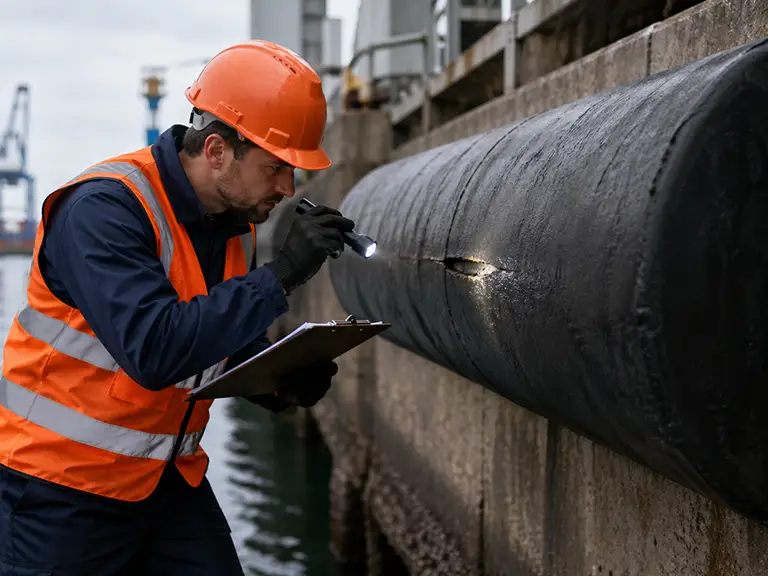
During each inspection, check for: cuts, gouges, or tears in the polyurethane skin; deformation or permanent compression of the foam core; corrosion on chain attachments and mounting hardware; and UV degradation or surface cracking on the outer skin.
If the skin is damaged but the foam core is intact, the fender can continue operating. However, schedule a skin repair to prevent water ingress over time. Replace the fender if the foam core shows permanent deformation beyond 10% of original diameter.
Frequently Asked Questions
What is the difference between a foam fender and a pneumatic fender?
How much energy can a foam fender absorb?
Do foam fenders meet military specifications?
How long do foam fenders last?
Are foam fenders non-marking?
Can foam fenders work in extreme temperatures?
Talk to our team.
Share a few details about your project — vessel, port, or operation. We'll reply within 24 hours.