


Marine fenders protect vessels and port structures during berthing and mooring. Choosing the wrong type can lead to hull damage, costly repairs, and operational downtime. This guide covers five main types of marine fenders. For each type, you will find key features, technical performance data, recommended uses, and guidance on when to choose one type over another.
Quick Comparison: 5 Types of Marine Fenders
| Fender Type | Energy Absorption | Reaction Force | Best For | Installation |
|---|---|---|---|---|
| Yokohama (Pneumatic) | High | Low–Medium | STS operations, tidal ports | Floating, hung from vessel |
| Cell | Medium–High | Low | Fixed berths, terminals | Bolted to quay wall |
| Cone | High | Medium | Large vessels, dolphins | Bolted to quay wall |
| Arch | Low–Medium | Low | Small/medium vessels, tight spaces | Bolted vertically or horizontally |
| Pile | Low–Medium | Low | Specific vessel types, combined systems | Mounted on pile or panel |
Yokohama Fender
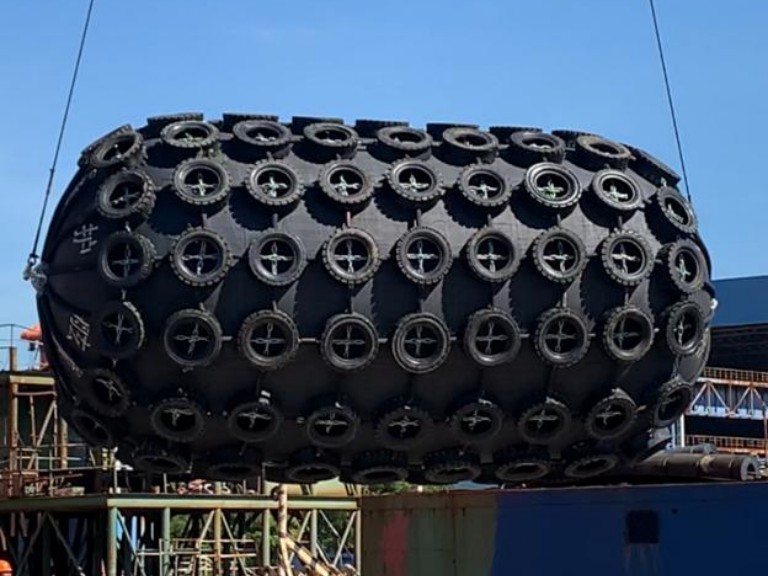
Yokohama Fender has been in widespread use for more than 50 years. They are considered the best way to prevent collisions. This is because they are the easiest to use and are inexpensive. Pneumatic marine fenders are cylindrical airbags made of rubber that are filled with air. This allows the fender to float freely in the water.There are various types of pneumatic rubber fenders depending on the application.
In addition, pneumatic marine fenders can usually be fitted with a tyre or chain mesh on the outside. This provides better coverage of the fender’s body. Pneumatic marine fenders are very flexible and suitable for a variety of situations. For example, when there are changes in the tides or when the boats do not match.
Key Technical Data
- Energy absorption: 45 kNm (500×1,000 mm) to over 14,000 kNm (4,500×12,000 mm)
- Can withstand up to 80% compression without permanent damage
- Available in net-type or sling-type configurations
- External tyre or chain-and-tyre net protection is standard
Key Features
- Floats freely — adapts automatically to tidal changes
- No fixed installation required
- Suitable for vessels of very different sizes
- Can be fitted with chain-and-tyre nets for abrasion resistance
- Requires minimal permanent infrastructure
Recommended Uses
- Ship-to-ship (STS) lightening operations
- Ports with large tidal variations
- Offshore oil and gas facilities
- Temporary or emergency berthing
- Submarine or naval vessel protection
When NOT to Choose a Yokohama Fender
Yokohama fenders are large and heavy. They require crane support for deployment and retrieval. They are not suitable for small craft harbours or permanent fixed berths where a bolted fender system is more practical.
Cell Marine Fenders
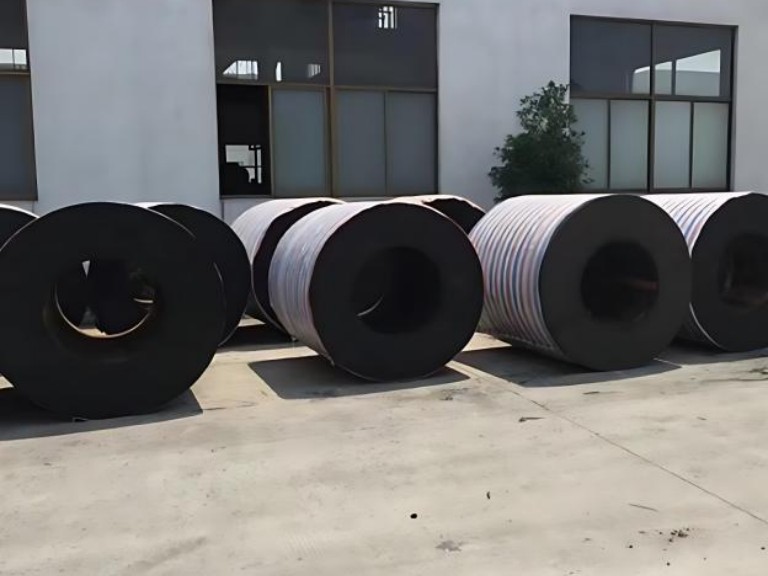
Cell marine fenders are the most commonly used marine fender type in the commercial sector. They are usually made of rubber and are very flexible, which makes them suitable for use between ships and docks. In addition, they are usually round with a hole in the middle to provide optimum low reaction forces. Cell marine fenders are therefore ideal for keeping ships and moorings safe during docking.
A cellular marine fender is robust, absorbs water well, and has a long service life. These are three important qualities that all marine fenders should have. Durability is important because if the fender doesn’t last, you’ll have to keep buying new ones. This increases costs and reduces profitability.
Key Technical Data
- Can deflect up to 50% of the berthing force in the axial direction
- Low reaction force makes them suitable for vessels with sensitive hull structures
- Typical service life: 15–25 years with regular inspection
- Compression at rated performance: approximately 52.5%
Key Features
- Low reaction force — reduces stress on vessel hull and quay structure
- High energy absorption relative to size
- Robust and resistant to wear
- Easy to install and replace individually
- Suitable for high-frequency berthing operations
Recommended Uses
- Container berths
- Bulk cargo terminals
- LNG and oil facilities
- RoRo and cruise terminals
- Offshore platforms
- Multi-user berths with varying vessel sizes
When NOT to Choose a Cell Fender
Cell fenders are fixed structures. They are not suitable for operations where the fender must move with the vessel or adapt to extreme tidal changes. For those situations, a Yokohama fender is a better choice.
Cone Marine Fenders
Cone marine fenders are a variant of cellular fenders that are becoming increasingly well-known in the commercial sector. Their construction means they can cope with a wide range of situations. Cone marine fenders can be used for large vessels such as tankers and cruisers. As they are based on cellular fenders, they are very similar in construction and have many of the same features.
Tapered fenders can withstand the strong impacts from large vessels. They are conical in shape and fitted with a flange to provide stability. This means that the enormous impact forces are evenly distributed and neither the vessel nor the quay is damaged. They have proven their effectiveness in many different tidal conditions.
How Cone Fenders Differ from Cell Fenders
This is a common point of confusion. Here is a clear comparison:
| Feature | Cell Fender | Cone Fender |
|---|---|---|
| Shape | Cylindrical with open centre | Conical with solid body |
| Reaction force | Lower | Higher |
| Angular performance | Moderate | Superior |
| Best for | Standard terminals | Large vessels, dolphins |
| Tidal adaptability | Moderate | Good |
Key Technical Data
- High shear stability — performs well even under angular compression
- Suitable for berthing angles up to 10°
- Stable under both axial and shear loads
- Flange base distributes load evenly to the quay structure
Key Features
- Superior angular performance compared to cell fenders
- Even load distribution across the mounting flange
- Long service life due to efficient geometry
- Suitable for large vessels with high berthing energy
Recommended Uses
- Tankers and LNG carriers
- Cruise ship terminals
- Dolphins and monopile structures
- Cargo berths handling large vessels
- RoRo terminals with variable berthing angles
When to Choose Cone Over Cell
Choose a cone fender when your berth regularly handles large vessels and when the berthing angle is variable or difficult to control. Choose a cell fender when reaction force minimisation is the priority and berthing conditions are more predictable.
Arch Marine Fenders
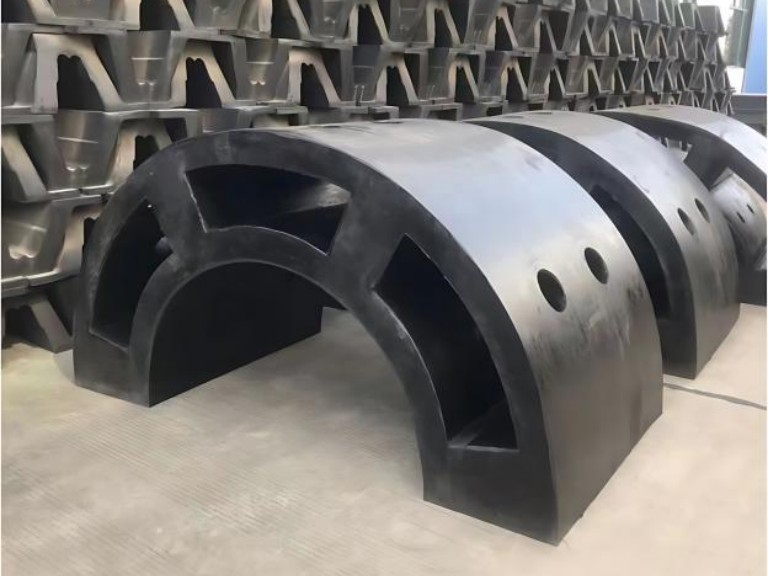
Arch marine fenders can be used for small and medium-sized vessels in most situations. They are ideal for tight spaces or where access is difficult. Arch fenders are one-piece designs that can be secured vertically or horizontally on each side to the required area. This means that the fender can withstand high pressure without breaking.
Although smaller than most fenders, the arch fenders are still extremely durable. Thanks to the way they are made, they provide excellent protection for boats and a range of mooring situations, even in the harshest conditions. What’s more, they are very flexible and customizable and can be adapted to your needs.
Key Technical Data
- One-piece construction — no joints or mechanical connections to fail
- Available in a wide range of standard sizes
- Can be bolted directly to steel plates or concrete structures
- Typical compression at rated performance: approximately 35%
Key Features
- Compact design — suitable for locations with limited installation space
- One-piece rubber body increases tensile strength and durability
- Simple bolt-on installation — no special tools or equipment required
- Can be mounted vertically or horizontally
- Low maintenance requirements
- Suitable for a wide range of marine environments
Recommended Uses
- Cargo berths
- Ferry and cruise ship harbours
- Workboat harbours
- Barge and tugboat berths
- Lock gates and canal structures
- Locations where space for larger fenders is limited
When NOT to Choose an Arch Fender
Arch fenders are best suited for small to medium-sized vessels. They are not designed for the high berthing energies generated by large tankers, bulk carriers, or cruise ships. For those vessels, cone or cell fenders are more appropriate.
Pile Marine Fenders
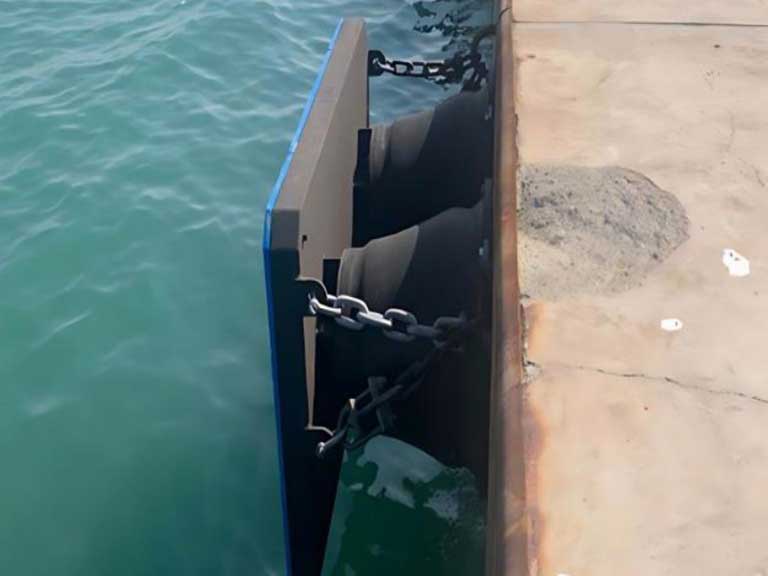
Pile fenders ensure that the ship and the fender only come into contact at one point, regardless of the water level. To provide optimum safety, the fenders must be tailored to each ship. This means that they can come in a variety of variations. Pile marine fenders are made from a single panel and are suitable for protection against specific ships.
You will find this type of fender often used in conjunction with the other types mentioned earlier. They are therefore very flexible and can provide good protection in many different situations. Most often, they are used in conjunction with tapered and cellular marine fenders.
Key Technical Data
- Contact point remains constant regardless of water level
- Often used in combination with cell or cone fenders
- Panel construction allows customisation for specific vessel hull profiles
- Suitable for single-vessel or dedicated berth applications
Key Features
- Consistent contact point across all tide levels
- Can be tailored to the hull profile of a specific vessel
- Compatible with other fender types (commonly paired with cell or cone fenders)
- Suitable for locations where the vessel approaches from a fixed direction
Recommended Uses
- Dedicated berths for specific vessel types
- Ferry terminals with fixed approach angles
- Combined fender systems alongside cell or cone fenders
- Structures where tidal variation would otherwise cause inconsistent contact
When NOT to Choose a Pile Fender Alone
Pile fenders work best as part of a combined system. On their own, they offer limited energy absorption. Pairing them with cone or cell fenders provides both consistent contact and adequate energy absorption capacity.
Maintenance Overview by Fender Type
| Fender Type | Inspection Frequency | Common Wear Signs | Typical Service Life |
|---|---|---|---|
| Yokohama | Before each deployment | Pressure loss, surface cracking, chain wear | 10–15 years |
| Cell | Every 6–12 months | Surface abrasion, bolt corrosion, deformation | 15–25 years |
| Cone | Every 6–12 months | Flange bolt loosening, surface cracking | 15–25 years |
| Arch | Every 6–12 months | Surface cuts, bolt loosening | 10–20 years |
| Pile | Every 6–12 months | Panel wear, pile corrosion | 10–20 years |
Summary
Marine fenders are essential tools for ensuring the safety and efficiency of operations at sea. Different types of marine fenders have their own unique uses. They can cater to different vessel sizes, environmental conditions, and mooring requirements. Choosing the right marine fender is essential for protecting vessels and port infrastructure from potential damage during berthing or mooring.
With technological advancements, Zhonghaihang marine fenders offer increased durability, flexibility, and performance. This makes them a valuable investment in maintaining the safety and longevity of the marine environment. If you have any further questions, don’t worry. Zhonghaihang’s team of experts is on hand to answer any questions you may have and to address any concerns you may have before purchase.
Talk to our team.
Share a few details about your project — vessel, port, or operation. We'll reply within 24 hours.