

PIANC Fender Guidelines 2024 sets out how berth fender systems should be designed, manufactured and tested, and which evidence should follow that work into a tender. The association issues no certificates of its own; type approval under the 2024 report comes from an independent third party. What a supplier’s claim is worth therefore depends on three things: the class of test evidence behind it, the edition behind the quoted performance figures, and the operational data the buyer can supply. Floating pneumatic units need a further document set, because the report sends their prototype performance procedure to ISO 17357.
What does a “PIANC compliant” claim prove on a fender quotation?
A compliance claim on a quotation comes from the supplier, and its weight depends on which class of test evidence stands behind it. The 2024 report gives the point a numbered subsection of its own, 1.5, titled PIANC Certified Fenders and PIANC Type Approval. The same front matter tells readers that conformity is not obligatory, that engineering judgement applies, and that the association disclaims responsibility if anyone presents the report as an official standard.
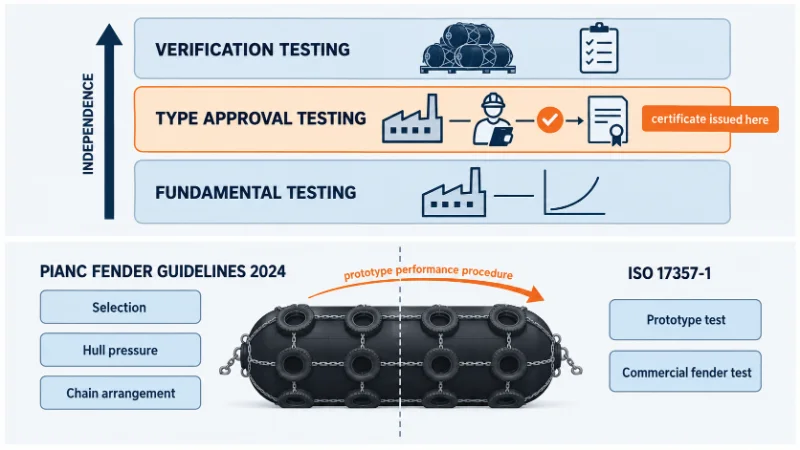
Test evidence comes in three classes. Fundamental testing establishes the catalogue basis for a product range, whether the manufacturer runs it in house or engages a laboratory. Type approval testing is that same catalogue data observed or confirmed by an independent qualified third party, which is what turns it into a certificate. Verification testing is project-specific work on the fenders a particular specification buys. A quotation that names none of the three has said nothing about who checked what.
The three classes also settle a date question. The transition period let suppliers reorganise catalogues and carry out the type approval testing that requires, so it bears on published data rather than on hardware already in service. Publication of the 2024 report does not make an installed fender defective because someone designed it under the 2002 one.
| Wording on the quotation | Who issues it | What it demonstrates | What to ask for |
|---|---|---|---|
| PIANC certified / PIANC approved | Nobody; the association runs no certification scheme | Nothing, because the status does not exist | Which of the three test classes the supplier means |
| PIANC compliant / WG 211 compliant | The supplier | An unscoped claim that may cover design, manufacturing, testing, or all three | Which of the three it covers, in writing |
| Type approval to WG 211 | An independent qualified third party | Catalogue data verified within the scope stated on the certificate | Whether the quoted geometry, rubber grade and size fall inside that scope |
| Fundamental testing | The manufacturer, or a laboratory it engages | The catalogue basis for a product range | Whether an independent party observed or confirmed the work |
| Verification testing | The parties named in the purchase specification | That units supplied against this project meet the stated requirements | Which tests your specification makes mandatory |
| Third-party witnessed / third-party tested | Varies, and the phrase does not say which | Only that a third party was present for something | The third party’s scope: witnessing, material tests, type approval or project verification |
| Abnormal berthing factor | Vocabulary from the 2002 report | That the underlying calculation may still be on the older method | Confirmation of which edition the energy calculation used |
Which edition are the quoted performance figures built on?
The edition behind a performance table decides whether a tender can compare its numbers with anything else. The 2024 report replaced the 2002 method instead of adjusting it. The association’s publication entry for the report states that users cannot simply swap the old report number for the new one in their own specifications. Doing so brings significant cost increases, because the design approach behind the two is different.
One tell is reliable. An abnormal berthing factor in a current quotation points to the 2002 calculation, because the 2024 method replaced that single allowance with a partial energy factor.
Two other tells are weaker and often misread. A performance figure quoted without naming which stage it sits at should prompt a question. A berthing velocity taken from a table proves nothing on its own, because the 2024 report still supplies velocity values for berths where site knowledge is unavailable. What matters is whether the quotation records that anyone looked for site data.
A table can be relabelled while a test basis cannot, so check the calculation basis and the type approval scope separately.
Two items have to settle together before the rest of a tender can be compared: the edition behind the performance figures, and the operational data the buyer can supply. The edition is confirmed first, because it is the input to every later comparison.
| Design input | Under the 2002 report | Under the 2024 report | What the buyer has to supply |
|---|---|---|---|
| Berthing velocity | Read from tables by vessel size and exposure | Site-specific data preferred, with tables used where no site knowledge exists | Pilot, harbourmaster or tug master records, or a statement that none exist |
| Safety allowance | One abnormal berthing factor by vessel type and size | A partial energy factor drawing on consequence class, navigation conditions, displacement variation, contact mode, berthing frequency and pilot assistance | Berthings per year, whether a pilot attends, the displacement range actually working the berth, and whether one fender or several take the contact |
| Quoted performance | Rated energy at constant velocity | Base performance, then characteristic performance after correction factors, then design performance after partial resistance factors | Confirmation of which stage the quoted figure sits at |
| Consequence of failure | Not formalised | A consequence class selected by the owner | Berth redundancy and available alternative berths |
Why do the PIANC Fender Guidelines not automatically change your fender size?
Fender size under the 2024 method moves in either direction depending on the data behind it. Re-running an existing berth can return a smaller unit or a larger one. The association’s published summary is explicit on both outcomes: where a designer uses site-specific information, fenders come out slightly smaller than under the 2002 method, and where local knowledge is ignored, they may be over designed.
The mechanism is the partial energy factor, which took over the job of the old abnormal berthing factor. Instead of reading one figure from vessel type and size, the method draws on the consequence class, the navigation conditions at the berth, variation in vessel displacement, whether one fender or several take the contact, how often the berth is used, and whether a pilot attends. Most of those are operational records, held by the port or the terminal and not by the fender manufacturer.
A buyer who cannot produce them still gets an answer. That answer rests on fallback assumptions, and the guideline’s fallback berthing velocities carry a conservative tendency by design. Other fallback assumptions need checking one at a time. The bottleneck in a 2024-based enquiry therefore moves from the supplier’s performance curve to the owner’s operating records, which makes it a procurement change as much as a technical one.
Working the energy calculation through to a selected size is a separate exercise and belongs with the berth designer. At quotation stage the useful question is narrower: do the inputs exist, and who produces them.
For a berth that nobody is rebuilding, the 2024 report changes what a new specification should say, not what an installed fender is. An existing asset answers to the basis in its own contract and to its current condition. A reassessment follows a change in the vessel envelope, in how the berth is worked, or in the condition of the units themselves.
Where do the 2024 guidelines hand pneumatic fenders back to ISO 17357?
Floating pneumatic fenders sit inside the 2024 report for selection, hull pressure and chain arrangement, while a separate standard holds the prototype performance procedure. The report’s contents list places them in the chapter on fendering principles, among the factors influencing system selection, in the hull pressure section, in the chain arrangement figure and in the manufacturing chapter. The test chapter keeps a subsection on their rubber compounds and another on their performance tests. The two share a single page.
What the 2024 report did not carry forward is the standalone prototype-performance procedure that the 2002 report set out in an appendix. Trelleborg’s published chapter overview describes the change as referring testers to ISO 17357 instead. ISO 17357-1:2014 covers the material, performance and dimensions of high-pressure floating pneumatic rubber fenders, together with their test and inspection procedures. Its classification clause sets out the types of pneumatic fenders. Clause 8 covers performance confirmation by prototype test, and Clause 9 covers the tests and inspections applied to commercial fenders.
Reading that evidence takes three layers, and a quotation should name all three. The first is a prototype test certificate under Clause 8, evaluated by a major classification society and dated within ten years of the enquiry. The second is a commercial fender inspection and test certificate. It qualifies an enquiry when it comes from a fender of equal or larger diameter at the same or higher internal pressure, also within ten years.
That document does not have to come from the order being quoted. Treating it as proof that your own units were tested is the most common misreading of the standard.
The third is whatever testing and independent inspection the purchase specification calls for on the units supplied, which the standard treats as an option to state at enquiry.
Where the two documents meet is the design side. The 2024 report still covers how many pneumatic fenders a ship-to-ship or stand-off arrangement needs, and what hull pressure that arrangement may impose. The ISO standard covers what the individual unit has been built and tested to.
What changed, and when did it take effect?
Three dated items in the report’s own record bear on a live enquiry: when PIANC published it, when the transition period closed, and what it leaves outside its scope.
Publication: PIANC issued PIANC Fender Guidelines 2024 in March 2024 as MarCom Working Group 211, and it completely supersedes the 2002 report along with other PIANC berthing guidance. Source: the association’s publication entry. Action: check that any specification issued after that date names the edition it intends to invoke.
Transition period: The period between the two editions let fender suppliers reorganise catalogues and carry out the type approval testing that requires. It ended on 1 May 2026, two years after publication. That period has now closed. Source: the same entry. At least one supplier’s published overview gives 1 November 2025 for the same period, so the end date in circulation is inconsistent. The association’s own page is the one to cite in a specification. Action: where a supplier quotes a different date, ask which document it came from.
Scope boundary: The report addresses seagoing vessels on controlled berthing manoeuvres, usually tug assisted or thruster equipped. It does not provide design guidance for inland vessels and barges, and it does not cover collision protection structures such as bridge piers or guidance for lock chambers. Source: the same entry. Action: for a barge berth or a pier protection scheme, establish which basis the design sits on before accepting a 2024 reference in the specification.
Where does a PIANC claim end and an ISO 17357 certificate begin?
Two variables decide which document a fender enquiry should name: the edition behind the performance data, and the operational records the owner can put behind the energy calculation. Everything else in a PIANC Fender Guidelines comparison inherits those two. Specifications that name an edition but leave the velocity basis unstated are the ones that produce two incomparable quotations, because each supplier fills the gap with a different default.
Which of the three situations below applies decides whether the next request is an edition confirmation, a type approval scope check, or an ISO 17357 certificate set. Where an existing specification still cites the 2002 report, do not simply renumber the reference. It becomes meaningful only once the velocity basis and the safety allowance are rewritten to match.
Where a quotation claims compliance with the 2024 report, ask for the type approval certificate plus the third party’s scope, checked against the geometry, grade and size actually quoted. Where the purchase is floating pneumatic fenders, ask for the ISO 17357 set, with prototype and commercial certificates separately identified. Compliance language pointing at the 2024 report then reads as a statement about design and selection.
FAQ
Is PIANC Fender Guidelines 2024 still the current edition?
Does citing the 2024 report in a specification make it binding?
What should a buyer do if a supplier only has fundamental test data?
How often should a fender specification be checked against the current edition?
What does “PIANC 2002 certified” on an older datasheet mean?
Talk to our team.
Share a few details about your project — vessel, port, or operation. We'll reply within 24 hours.