

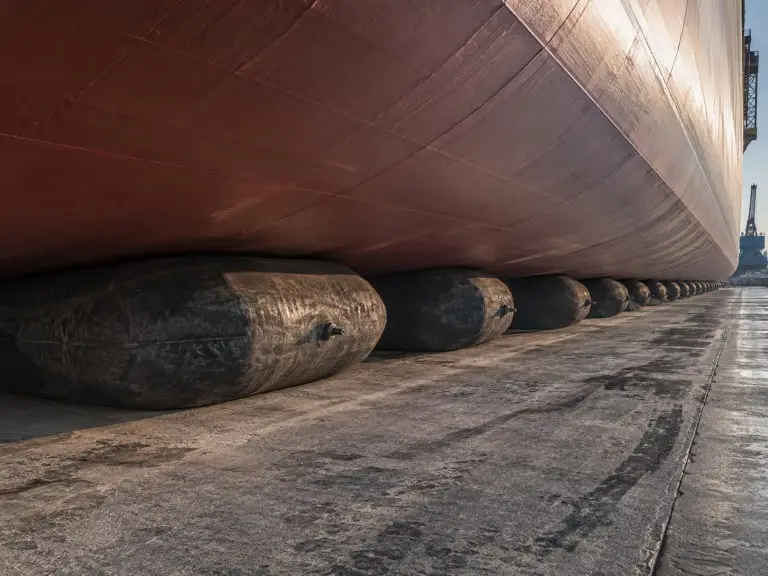
Ship launching airbag price is not quoted by weight or at a flat per-unit rate. It is calculated from the airbag’s surface area — determined by diameter, effective length, and cord layer count. Understanding this calculation separates a meaningful supplier comparison from a figure that will change once the engineering review begins.
We supply custom marine airbags for ship launching, haul-out, and offshore lifting operations. This guide covers how airbag price is calculated, which variables drive cost, and what inputs produce a reliable project-ready quote.
How Ship Launching Airbag Price Is Calculated
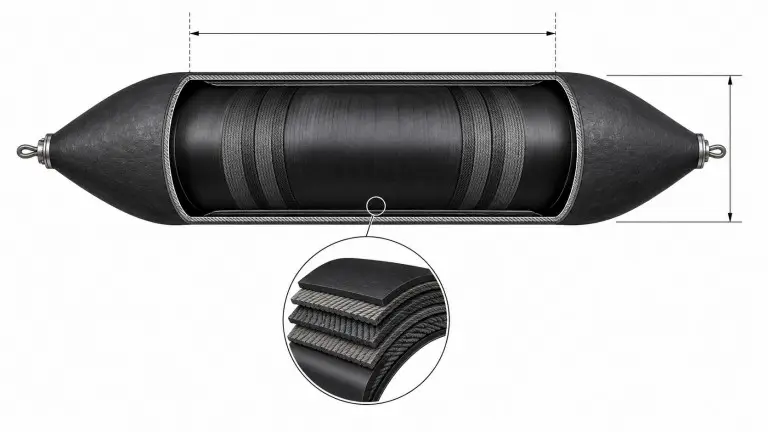
Ship launching airbag price is based on surface area, using the formula:
S = π × D × (D + Le) × N
Where D is the outside diameter in meters, Le is the effective cylindrical length excluding cone ends in meters, and N is the number of synthetic tire-cord layers. Multiply that surface area by the unit surface rate to get the unit price.
The unit surface rate typically runs USD 4 to USD 8 per square meter across compliant manufacturers. The spread reflects cord material grade and certification scope — not margin alone.
Worked Examples
Two worked examples using the same geometry but different layer counts:
- 1.5 m × 15 m, 4-layer: S = π × 1.5 × 16.5 × 4 ≈ 311 m² → at USD 6/m² ≈ USD 1,866 per unit
- 1.5 m × 15 m, 6-layer: S = π × 1.5 × 16.5 × 6 ≈ 466 m² → at USD 6/m² ≈ USD 2,796 per unit
Layer count — not overall dimensions — creates the largest cost step between specifications. When two supplier quotes differ for the same stated size, check whether the layer count, cord specification, and effective length definition are actually identical. A lower per-piece price without a confirmed specification match is not a saving. It is an unverified specification change.
Reference Price Table
The table below applies the formula across common specifications at the USD 4–8/m² rate. These are reference estimates. Actual quotes depend on material grade, certification scope, and accessories.
| Specification | Diameter | Eff. length | Layers | Surface area | Est. unit cost |
|---|---|---|---|---|---|
| Small / light vessel | 1.0 m | 10 m | 4 | ≈ 138 m² | USD 553–1,106 |
| Standard | 1.5 m | 15 m | 4 | ≈ 311 m² | USD 1,244–2,488 |
| Mid-weight | 1.5 m | 18 m | 6 | ≈ 551 m² | USD 2,206–4,412 |
| Heavy | 2.0 m | 18 m | 6 | ≈ 754 m² | USD 3,016–6,032 |
| Large vessel | 2.0 m | 20 m | 8 | ≈ 1,106 m² | USD 4,422–8,845 |
When comparing quotes, we verify the surface area calculation and layer specification against the vessel’s load requirement before confirming any configuration.
The Four Variables That Determine Total Project Cost
Total project cost depends on four variables. They must be confirmed together — adjusting one typically shifts the others.
Layer Count
Layer count is set by the vessel’s launch weight and hull geometry, not by budget. Selecting fewer layers than the load calculation requires is a specification error, not a cost reduction. Upgrading from 4-layer to 6-layer on the same geometry increases surface area — and unit cost — by approximately 50%.
Diameter and Effective Length
Diameter and effective length affect both surface area and load distribution per meter of hull contact. Larger diameters suit hull forms with limited flat keel sections. They can also reduce the quantity needed by spreading load more effectively.
Quantity
Quantity required is the largest cost variable in most projects. It cannot be estimated from vessel hull length alone — it requires a proper load calculation, covered in the next section.
Certification Scope
Certification scope adds to unit cost. Third-party certification from BV, ABS, CCS, or LR requires material traceability, batch testing, and witness inspection — all arranged before production begins.
When reviewing a project scope, we confirm all four variables before generating a configuration recommendation. Changing any one adjusts both unit cost and the required quantity.
Type Selection and Its Cost Implications
Airbag types differ by cord layer count and the resulting bearing capacity per linear meter. Naming conventions vary by manufacturer — QP/QG/QS, SS-3 through SS-6, and others are all in use. Layer count and test-confirmed load capacity per meter govern selection and cost, regardless of the naming system.
| Type | Cord layers | Load capacity / meter (indicative) | Cost implication |
|---|---|---|---|
| Ordinary | 3–5 layers | ~10–20 t/m | Lowest surface area; suits small vessels and barges |
| High-bearing | 6–8 layers | ~20–35 t/m | Mid-range; covers most tanker and cargo vessel launches |
| Super-high-bearing | 9+ layers | ~35–50+ t/m | Highest unit cost; required for large or heavy vessel classes |
Load capacity per meter is also affected by airbag diameter and inflation pressure. The values above are indicative planning ranges. Confirmed capacity for a specific product must come from the manufacturer’s test report.
When selecting a type, we start from the vessel’s launch weight and required load capacity per meter. We then check whether the resulting quantity is viable for the site geometry. When site constraints limit how many airbags can be positioned, the type may need to step up, as the required load margin varies across methods of ship launching.
How Quantity Drives Total Project Budget
Quantity is the most frequently underestimated cost variable in airbag procurement. It is calculated using the ISO 17682:2013 formula:
N = K₁ × Q × g / (Cb × R × Ld)
Where K₁ is the distribution coefficient (≥ 1.2), Q is the vessel launch weight in tonnes, g = 9.8 m/s², Cb is the hull block coefficient, R is the allowable bearing capacity per meter in kN/m, and Ld is the effective contact length between hull bottom and airbags in meters.
Block Coefficient and Contact Length
Cb and Ld both affect the count. A higher block coefficient means more hull length provides usable contact area, which reduces the required number. Ld is not the vessel’s overall length. For V-form hulls, the effective flat-keel contact zone is shorter than total hull length suggests. More units or a larger diameter may be needed to keep contact pressure within the 0.12 MPa limit — exceeding this threshold introduces ship launching risks that affect both cost and schedule.
Any quantity estimate based on hull length alone will need revision once the engineering parameters are confirmed. We run the ISO 17682 quantity calculation as part of every scope review before finalizing a quote.
Certification Scope and Its Effect on Quoted Price
Two standards govern ship launching airbag projects. They cover different scopes.
ISO 14409:2011 — Product Standard
ISO 14409:2011 is the product standard. It covers airbag materials, dimensions, test methods, and marking. Compliance should be confirmed from the manufacturer’s type-test report. This includes burst testing results against the minimum burst pressure for the product type and size. The safety margin achieved should come from the test report — not from a general supplier statement.
ISO 17682:2013 — Methodology Standard
ISO 17682:2013 is the methodology standard. It covers airbag quantity calculation, arrangement, slipway requirements, towing force, procedure, and safety. Referencing ISO 17682 in the project specification ensures the launching plan — not only the airbag product — is engineered to a defined standard.
Third-Party Certification
Third-party classification society certification — BV, ABS, CCS, or LR — must be confirmed at order placement. Material traceability and witness inspection cannot be arranged after production begins. We align on certification scope as part of every initial order review.
Inquiry Checklist: What to Provide for a Specification-Level Quote
An accurate quote requires seven inputs:
- Vessel launch weight (tonnes) — at the time of launch, not design loaded displacement
- Hull block coefficient (Cb) — from design documentation or lines plan
- Effective hull contact length (Ld) — or hull overall dimensions and form description if Ld is unknown
- Launching slope and ground conditions — slope angle and surface type (sand, gravel, silt, concrete)
- Required airbag diameter — or hull breadth at the keel if not yet selected
- Certification requirement — ISO 14409:2011 compliance and preferred classification body if applicable
- Number of planned launches — affects outer rubber thickness, reusability grade, and the point at which you will need to repair ship launching airbags
With these inputs, we confirm type, surface area, and required quantity in a single review cycle and return a project-ready quote.
Conclusion
Ship launching airbag pricing starts with surface area — scaled by diameter, effective length, and layer count — then multiplied by the unit surface rate. The total project cost is shaped by the quantity required and the certification scope. A lower per-unit price based on fewer layers or lower-grade cord rarely survives engineering review. The extra units needed to match the load margin usually cancel the saving.
In our experience, the most consistent source of budget variance is a quantity estimate made without the ISO 17682 calculation — specifically without confirmed vessel displacement and block coefficient. Both must be known before a quantity figure is reliable.
Share your vessel launch weight, hull block coefficient, contact length, slope conditions, and certification requirement with our team. We confirm the specification and required quantity in one review cycle and return a project-ready quote — not a preliminary estimate.
FAQ
How is ship launching airbag price calculated?
Why do two quotes for the same stated size differ significantly?
How many airbags does a project require?
When is third-party certification required?
What is the difference between ISO 14409 and ISO 17682?
Talk to our team.
Share a few details about your project — vessel, port, or operation. We'll reply within 24 hours.