

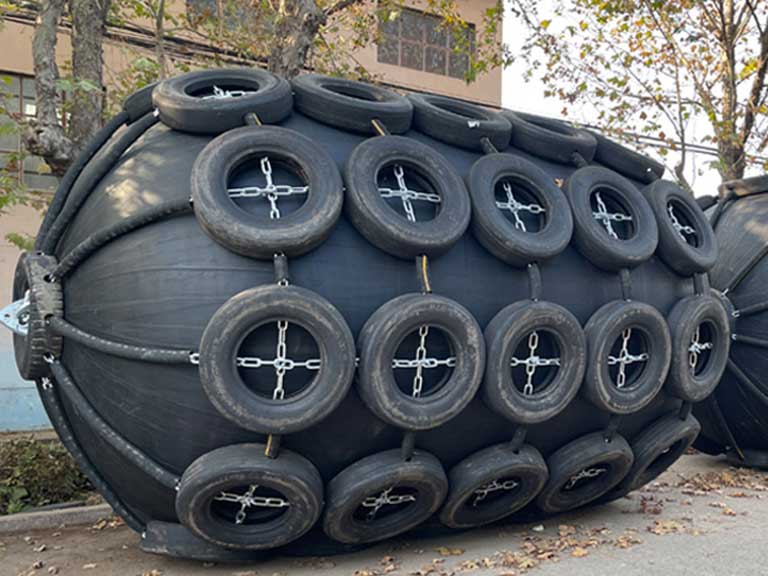
Yokohama rubber fenders are essential marine devices that protect ships and docks. Also known as floating pneumatic rubber fenders, they use compressed air to absorb impact during berthing or vessel transfers. This creates a soft buffer that minimizes damage. This guide uses industry standards and practical knowledge to help you choose the best fender. Selecting the right one ensures safety and efficiency for ship-to-ship (STS) and ship-to-dock (STD) operations.
Composition of Yokohama Pneumatic Fenders
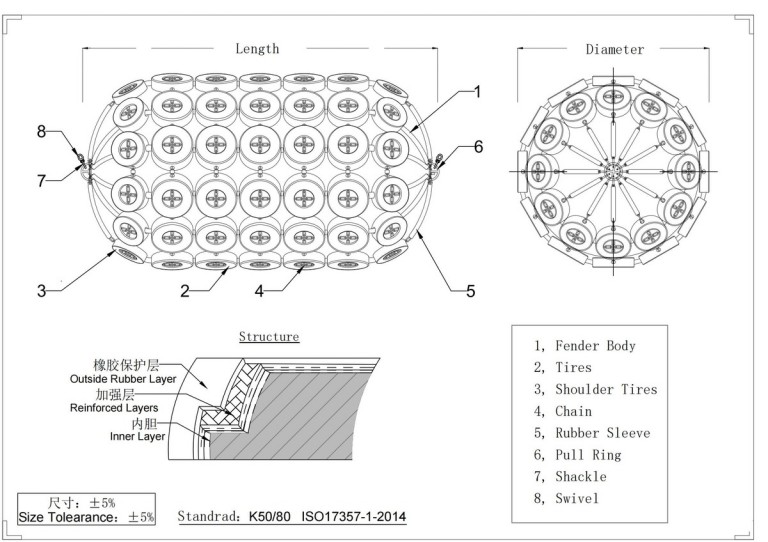
Yokohama pneumatic fenders are built with high-quality materials to withstand harsh marine conditions. They follow ISO 17357-1:2014, which remains the current standard as of 2026. A typical fender has several key parts:
- Outer Rubber Layer: This layer protects the fender’s inner structure from cuts, sunlight, and other external damage. It is made from reinforced rubber for a longer life.
- Inner Rubber Layer: This part seals the compressed air inside the fender. It prevents leaks and keeps the internal pressure steady.
- Cord Reinforcement Layer: This layer is made of strong synthetic tire-cord fabric. It gives the fender structural strength, allowing it to handle high pressure without bursting.
- End Rings or Flanges: These metal parts are at one or both ends of the fender. They secure the cord layers and hold valves for inflation and deflation. They also include safety features like pressure relief valves.
- Protective Net (Optional): Many models come with a chain-and-tire net. This net adds extra protection against punctures, especially in high-impact situations.
Advantages of Yokohama Pneumatic Fenders
Pneumatic fenders offer better performance than solid rubber or foam-filled types in dynamic marine settings. Key benefits include:
- High Energy Absorption with Low Reaction Force: They absorb large impacts while putting very little force on the ship’s hull. This reduces stress on the vessel.
- Ease of Installation and Portability: They are lightweight and can be inflated, making them easy to deploy. They can also be deflated for transport and storage.
- Adaptability to Conditions: These fenders float on the water and adjust to tidal changes or a ship’s movements. They do not permanently deform under pressure.
- Cost-Effectiveness: They have lower initial and maintenance costs compared to fixed systems. With proper care, they can last 10 to 15 years.
- Versatility: They are suitable for areas with extreme tidal changes, offshore platforms, and military ports.
However, they do need regular pressure checks. Under-inflation can reduce their performance.
Performance of Yokohama Pneumatic Fender
Fender performance depends on the initial pressure. The standard pressure is 50 kPa for most uses. For higher energy needs, 80 kPa is used. The table below shows performance data for common fender sizes at 60% deflection, which is the Guaranteed Energy Absorption (GEA). The data is based on ISO 17357-1:2014.
| Diameter x Length [mm] | 50kPa Performance Data | 80kPa Performance Data | ||||
| Hull Pressure at GEA / kN / m2 | Reaction Force /kN | Energy Absorption /kNm | Hull Pressure at GEA / kN / m2 | Reaction Force /kN | Energy Absorption /kNm | |
| 1000×1500 | 122 | 182 | 32 | 160 | 239 | 45 |
| 1000×2000 | 132 | 257 | 45 | 174 | 338 | 63 |
| 1200×2000 | 126 | 297 | 63 | 166 | 390 | 88 |
| 1350×2500 | 130 | 427 | 102 | 170 | 561 | 142 |
| 1500×3000 | 153 | 579 | 153 | 174 | 761 | 214 |
| 1700×3000 | 128 | 639 | 191 | 168 | 840 | 267 |
| 2000×3500 | 128 | 875 | 308 | 168 | 1150 | 430 |
| 2500×4000 | 137 | 1381 | 663 | 180 | 1815 | 925 |
| 2500×5500 | 148 | 2019 | 943 | 195 | 2653 | 1317 |
| 3300×4500 | 130 | 1884 | 1175 | 171 | 2476 | 1640 |
| 3300×6500 | 146 | 3015 | 1814 | 191 | 3961 | 2532 |
| 3300×10600 | 158 | 5257 | 3067 | 208 | 6907 | 4281 |
| 4500×9000 | 146 | 5747 | 4752 | 192 | 7551 | 6633 |
| *Other sizes can be produced following the client’s requirements. | ||||||
Learn More: What Is The Pressure In The Yokohama Fenders?
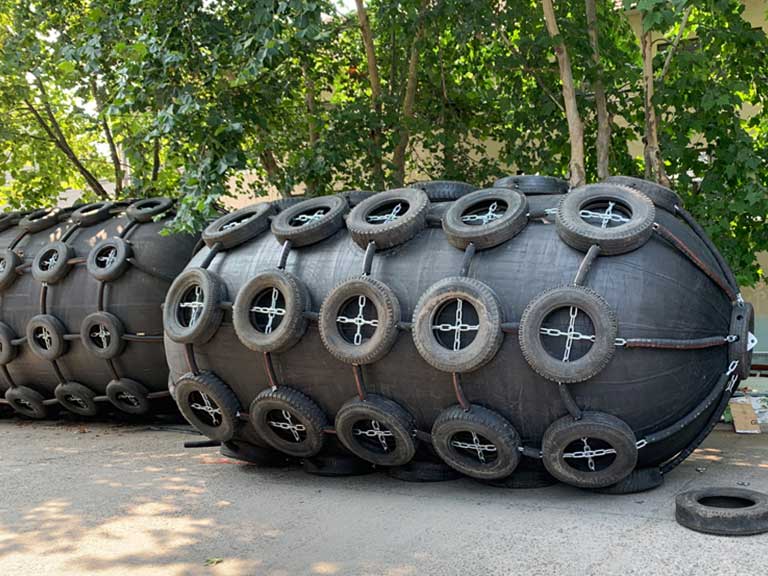
Selection of Yokohama Pneumatic Fenders: Step-by-Step Guide
Choosing the right fender starts with calculating the berthing energy of your vessel. Then, you match that energy to the fender’s specifications. Follow these steps:
- Calculate Effective Kinetic Energy (EKE): Use the formula E = 0.5 × M × V² × C_m × C_e × C_c × C_s. In this formula, M is the vessel’s displacement in tons and V is its berthing velocity in m/s. The “C” factors account for mass, eccentricity, configuration, and softness. These factors usually range from 0.4 to 1.0.
- Determine Pressure Rating: Choose 50 kPa for standard applications. Select 80 kPa for high-energy situations, such as with larger vessels or in rough seas.
- Select Size: Match the vessel’s EKE to the fender’s energy absorption capability.
- Check Certifications and Materials: Make sure the fender complies with ISO 17357. Look for third-party testing from groups like BV or ABS and confirm the use of quality materials.
- Consider Environmental Factors: Think about the tidal range, wind, waves, and the type of vessel.
Examples of Fender Options for Small and Medium-sized Ships
| Tonnage of Vessel (T) | Suitable Size D*L (m) | Vessel Type |
| 50 | 0.5*1.0 | Fishing boat |
| 100 | 0.7*1.5 〜1.07.5 | Fishing boat |
| 200 | L0*L5T2*2.0 | Fishing boat and tugboat |
| 300-500 | 1.2*2.0 〜1.525 | Fishing boat and tugboat |
| 1000 | 1.5*2.5 〜1.5*3.0 | Tugboat, transport vessel |
| 3000 | 2.0*3.0~2.0*3.5 | Ocean trawler, transport vessel |
| 10000 | 20*3.5-2.5*4.0 | Transport ship |
Examples of Fender Options for Large Ships
| Vessels (DWT) | Assumed landing speed (M/S) | Effective motion energy (KN.M) | Suitable Size D*L (m) |
| 200000 | 0.15 | 1890 | 3.3*6.5 |
| 150000 | 0.15 | 1417 | 3.3*6.5 |
| 100000 | 0.15 | 945 | 3.0*5.0 |
| 85000 | 0.17 | 1031 | 3.0*6.0 |
| 50000 | 0.1 | 600 | 2.5*5.5 |
| 40000 | 0.2 | 672 | 2.5*5.5 |
| 30000 | 0.22 | 609 | 2.5*5.0 |
| 20000 | 0.25 | 525 | 2.5*4.0 |
| 15000 | 0.26 | 425 | 2.5*4.0 |
| 10000 | 0.28 | 329 | 2.0*4.0 |
Maintenance and Installation Tips
To get the longest life from your fenders, follow these tips:
- Inflation: Keep the pressure between 50 and 80 kPa. Check it monthly with a pressure gauge.
- Inspection: The ISO standard requires an annual test for airtightness and pressure. Also, look for any cuts or leaks.
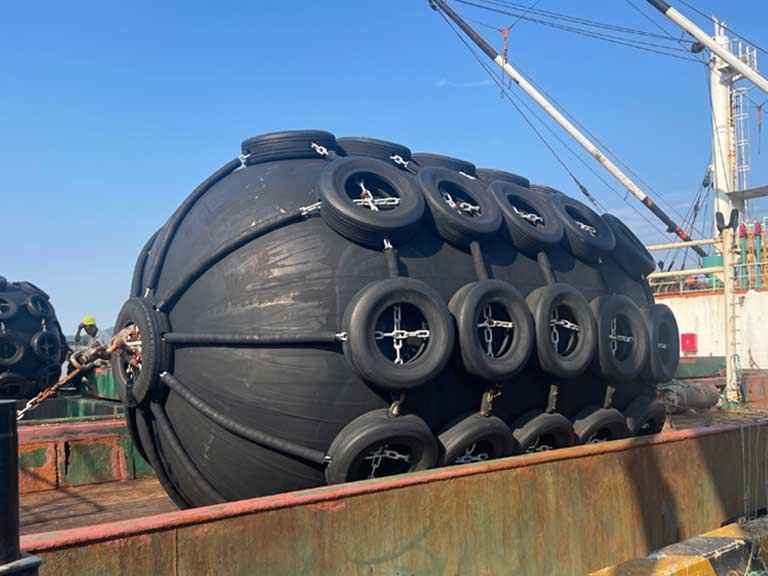
- Installation: For STS use, attach fenders with chains and swivels. Make sure they are spaced evenly. Always follow secure rigging guidelines.
Learn More: How To Maintain Pneumatic Fenders?
Summary
There are many different types of pneumatic fenders available in the market today. Thus, these Yokohama pneumatic fenders can be used for all types of ships and also to protect ports and harbors. Therefore, you can choose the right Yokohama fender for your needs. First, figure out where you will be using the fenders. Then, check out the previous section on pneumatic fenders and pick the fender that best suits your needs.
If you’re not sure which gas fender to choose, contact us. Zhonghaihang Shipping Supply is a leading marine equipment supplier in China. We have been committed to providing professional protection solutions for shipyards and port owners.
Frequently Asked Questions
What is the difference between Yokohama fenders and regular pneumatic fenders?
What are the two main pressure ratings (50 kPa vs. 80 kPa), and when should I choose one over the other?
What is the typical lifespan of a Yokohama pneumatic fender?
Talk to our team.
Share a few details about your project — vessel, port, or operation. We'll reply within 24 hours.