


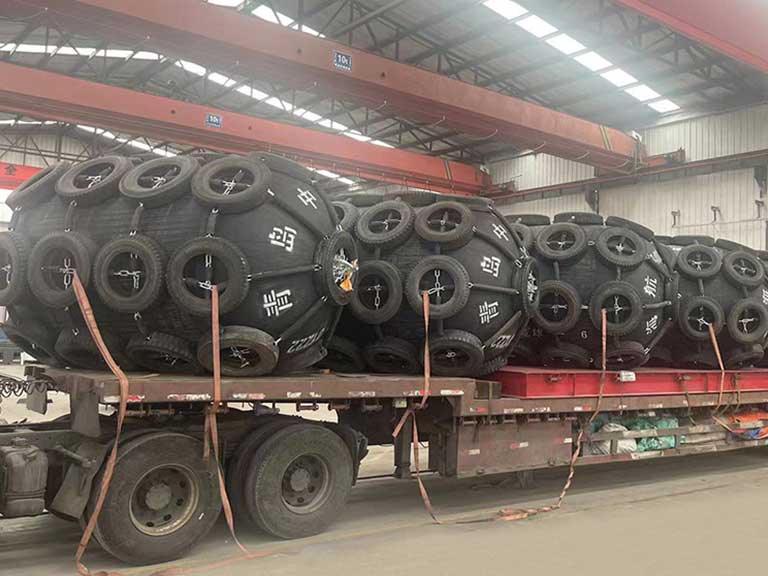
Yokohama fenders are the best option for STS operations worldwide. This self-floating, long-lasting fender is utilized in the majority of ship-to-ship (STS) operations aboard tankers. These marine fenders function in a very different way from solid rubber fenders. Yokohama fenders use pneumatic technology to absorb collision energy. In the industry, Yokohama fenders are sometimes referred to as pneumatic fenders.
Yokohama fenders are reasonably light and simple to install. If you buy high-quality goods, they will last a long time. There are numerous different types and perks to these pneumatic fenders.
Why Are They Called Yokohama Fenders?
The history of Yokohama fenders exemplifies maritime technological advancement. The Yokohama Rubber Company of Japan invented Yokohama fenders, sometimes known as pneumatic fenders, in the 1950s. These fenders marked a significant improvement in ship-to-ship and ship-to-dock transfer operations.
The concept of Yokohama fenders is quite basic. They are made of a tough rubber outer layer packed with pressurized air. This design has good shock absorption and energy absorption properties. Therefore, it is very suitable for protecting ships during berthing and docking.
Yokohama fenders make a significant contribution to the safety and efficiency of maritime operations. They prevent damage to ships and port infrastructure and allow for better handling of goods. Yokohama fenders are still widely used in shipping and the offshore industry around the world. This shows their long-term significance in the history of marine engineering.
How Did the Yokohama Fenders Come About?
In the past, people involved in marine activities discovered whale carcasses and used them as massive fenders for larger ships. However, there were numerous issues with employing whale carcasses as fenders on huge ships. So, beginning in the 1950s, many people sought a better, more dependable man-made tool.
Rubber was deemed to be a particularly good material. The first major issue discovered when beginning to manufacture fenders was the high expense of producing them straight from rubber. For example, if you want to make a regular fender with a diameter of 3.3 m x 6.5 m. In theory, this would take more than 70 cubic meters of rubber. The predicted expenditures made this hard to accomplish.
After much experimentation, Yokohama came up with the notion of using pneumatic technology. Pressurized air absorbs energy very well, as long as there is enough reaction force. Currently, the most typical working pressures for pneumatic fenders are 50 kPa and 80 kPa.
Yokohama Fenders Aren’t the Sole Man-made Option
Historically, floating fenders were not the only sort of fender employed when ships were moored. Some wheeled fenders and many smaller auxiliary fenders are also used.
These small auxiliary fenders are designed to prevent accidents between the stern and bow of the boat. In addition, wheeled fenders are used further away, while Yokohama fenders are used in the middle of the boat.
Yokohama Fender Sizes
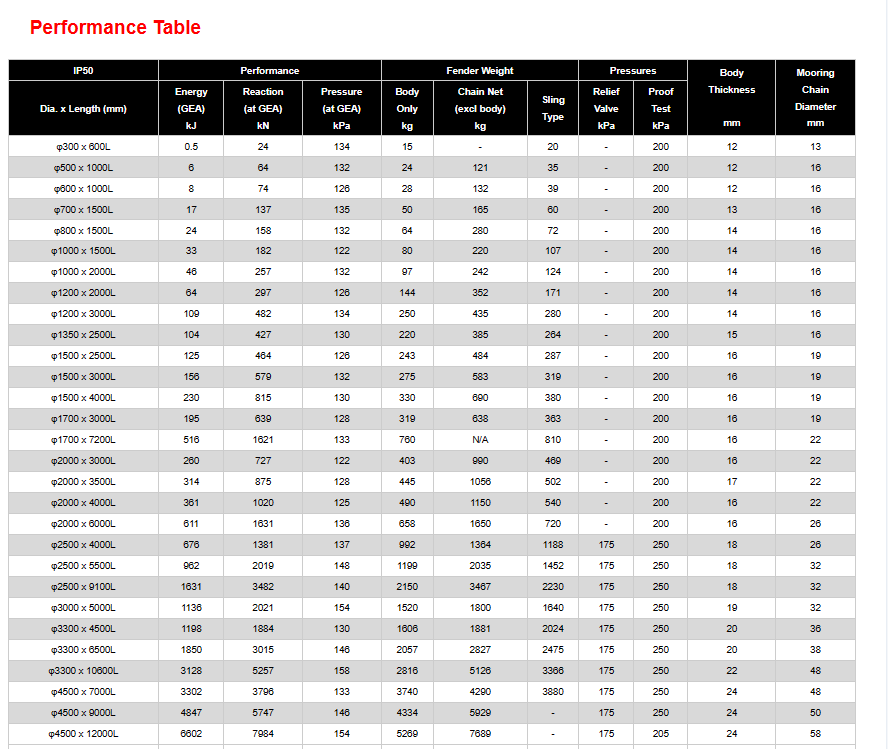
The history of pneumatic fenders is a fascinating aspect of the industry. These outstanding, low-cost, and easy-to-maintain fenders are now subject to ISO 17357:2014. ISO 17357-2:2014 describes the materials, features, and dimensions of floating pneumatic fenders.
Currently, the common Yokohama pneumatic fenders come in two standard sizes: 50 (metric) and 80 (metric).
| Pneumatic Fender 50 KPA Size and Performance | ||||
| Normal Size | Initial Internal Pressure(Kpa) | GEA | RF | PR |
| Diameter*Length(mm) | Guaranteed Energy Absorption(KN-m) | Reaction Force at GEA(KN) | Hull Pressure at GEA(Kpa) | |
| 500*1000 | 50 | 6 | 64 | 132 |
| 600*1000 | 50 | 8 | 74 | 126 |
| 700*1500 | 50 | 17 | 137 | 135 |
| 1000*1500 | 50 | 32 | 182 | 122 |
| 1000*2000 | 50 | 45 | 257 | 132 |
| 1200*2000 | 50 | 63 | 297 | 126 |
| 1350*2500 | 50 | 102 | 427 | 130 |
| 1500*3000 | 50 | 152 | 579 | 132 |
| 1700*3000 | 50 | 191 | 639 | 128 |
| 2000*3500 | 50 | 308 | 875 | 128 |
| 2500*4000 | 50 | 663 | 1381 | 137 |
| 2500*5500 | 50 | 943 | 2019 | 148 |
| 3300*4500 | 50 | 1175 | 1884 | 130 |
| 3300*6500 | 50 | 1814 | 3015 | 146 |
| 3300*10600 | 50 | 3090 | 5121 | 171 |
| 4500*7000 | 50 | 3816 | 4660 | 186 |
| 4500*9000 | 50 | 4752 | 5747 | 146 |
| 4500*12000 | 50 | 6473 | 7984 | 154 |
| Pneumatic Fender 80KPA Size and Performance | ||||
| Normal Size | Initial Internal Pressure(Kpa) | GEA | RF | PR |
| Diameter*Length(mm) | Guaranteed Energy Absorption(KN-m) | Reaction Force at GEA(KN) | Hull Pressure at GEA(Kpa) | |
| 500*1000 | 80 | 8 | 85 | 132 |
| 600*1000 | 80 | 11 | 98 | 126 |
| 700*1500 | 80 | 24 | 180 | 135 |
| 1000*1500 | 80 | 45 | 239 | 122 |
| 1000*2000 | 80 | 43 | 338 | 132 |
| 1200*2000 | 80 | 88 | 390 | 126 |
| 1350*2500 | 80 | 142 | 561 | 130 |
| 1500*3000 | 80 | 214 | 731 | 132 |
| 1700*3000 | 80 | 267 | 840 | 128 |
| 2000*3500 | 80 | 430 | 1150 | 128 |
| 2500*4000 | 80 | 925 | 1815 | 137 |
| 2500*5500 | 80 | 1317 | 2653 | 148 |
| 3300*4500 | 80 | 1640 | 2476 | 130 |
| 3300*6500 | 80 | 2532 | 3961 | 146 |
| 3300*10600 | 80 | 4294 | 6612 | 171 |
| 4500*7000 | 80 | 4945 | 5866 | 186 |
| 4500*9000 | 80 | 6633 | 7551 | 146 |
| 4500*12000 | 80 | 9037 | 10490 | 154 |
Types of Yokohama Fenders and Their Size Variations
Zhonghaihang offers many different types of Yokohama fenders. Each type has specific size variations to meet the unique challenges faced by maritime professionals. Our fenders are engineered to provide superior protection for various marine applications, ensuring the safety of vessels and infrastructure.
- Net Type (Type I) Fenders: Net Type fenders feature a protective chain tire mesh that covers the rubber body. It offers excellent abrasion resistance while maintaining optimal energy absorption characteristics. Sizes range from 300mm x 600mm to 4500mm x 12000mm.
Sling Type (Type II) Fenders: Sling fenders utilize different protection systems to make them suitable for applications with different expected contact surfaces. These include reinforced rubber protrusions and sling devices. They are available in the same comprehensive size range as Net Type fenders.
Special Types and Custom Sizes
For specialized applications, Yokohama offers various fender types with custom sizes. These include low-pressure fenders, vertical fenders, and hydropneumatic fenders. These fenders are intended to meet specific operational requirements.
- Low-Pressure Fenders: Low-pressure fenders are designed with lighter hull construction. They are ideally suited for applications that require large clearances between vessels or between vessels and docks.
Vertical and Hydro-Pneumatic Fenders: Vertical fenders and hydropneumatic fenders are designed for vertical installation. Hydropneumatic fenders utilize ballast water for stability. They are popular with vessels whose berthing point is below the water line.
| Fender Type | Size Range | Key Features |
| Net Type (Type I) | 300mm x 600mm to 4500mm x 12000mm | Chain tire net, abrasion resistance |
| Sling Type (Type II) | 300mm x 600mm to 4500mm x 12000mm | Reinforced rubber protrusions, sling arrangements |
| Low-Pressure | Custom sizes | Lighter body construction, large clearance |
| Vertical and Hydro-Pneumatic | Custom sizes | Vertical installation, water ballast for stability |
Precautions for Using the Pneumatic Fender
Yokohama fenders can be used for a variety of purposes. For example, they can be used for ship-to-ship and ship-to-quay operations and for mooring ships. However, there are some precautions you need to be aware of when using them:
- The pressure of the pneumatic fender should be kept within ±5% of the standard air pressure. In addition, the air pressure should be checked every three months and deflated or inflated to the standard level.
- Avoid contact with sharp objects, as this may cause damage.
- When not in use for a long time, clean and dry the pneumatic fender. Then pump in a moderate amount of air and store it in a cool, dry place with good ventilation.
- The place where the pneumatic fender is stored should be away from heat sources, acids, alkalis, and oil.
- Pneumatic fenders should not be folded or stacked when stored.

Contact us
With years of manufacturing experience and expertise, Zhonghaihang can provide customers with a large number of high-quality Yokohama fenders. We can provide pneumatic fenders in various sizes to meet your specific requirements. Notably, we can also provide you with samples. This way you can get a better idea of our products before purchasing.
In addition, our professional service team is always available to answer any questions you may have about pneumatic fenders. If you have specific needs, Zhonghaihang also offers customization options to meet your specific requirements. For example, we can customize the color of the product, print your brand logo, or provide other services.
FAQ
What is the recommended initial pressure for pneumatic fenders?
What are the benefits of using pneumatic fenders over traditional rubber fenders?
Can pneumatic fenders be customized to meet specific requirements?
What is the typical lifespan of a pneumatic fender?
How do I properly maintain and inspect my pneumatic fenders?
Talk to our team.
Share a few details about your project — vessel, port, or operation. We'll reply within 24 hours.